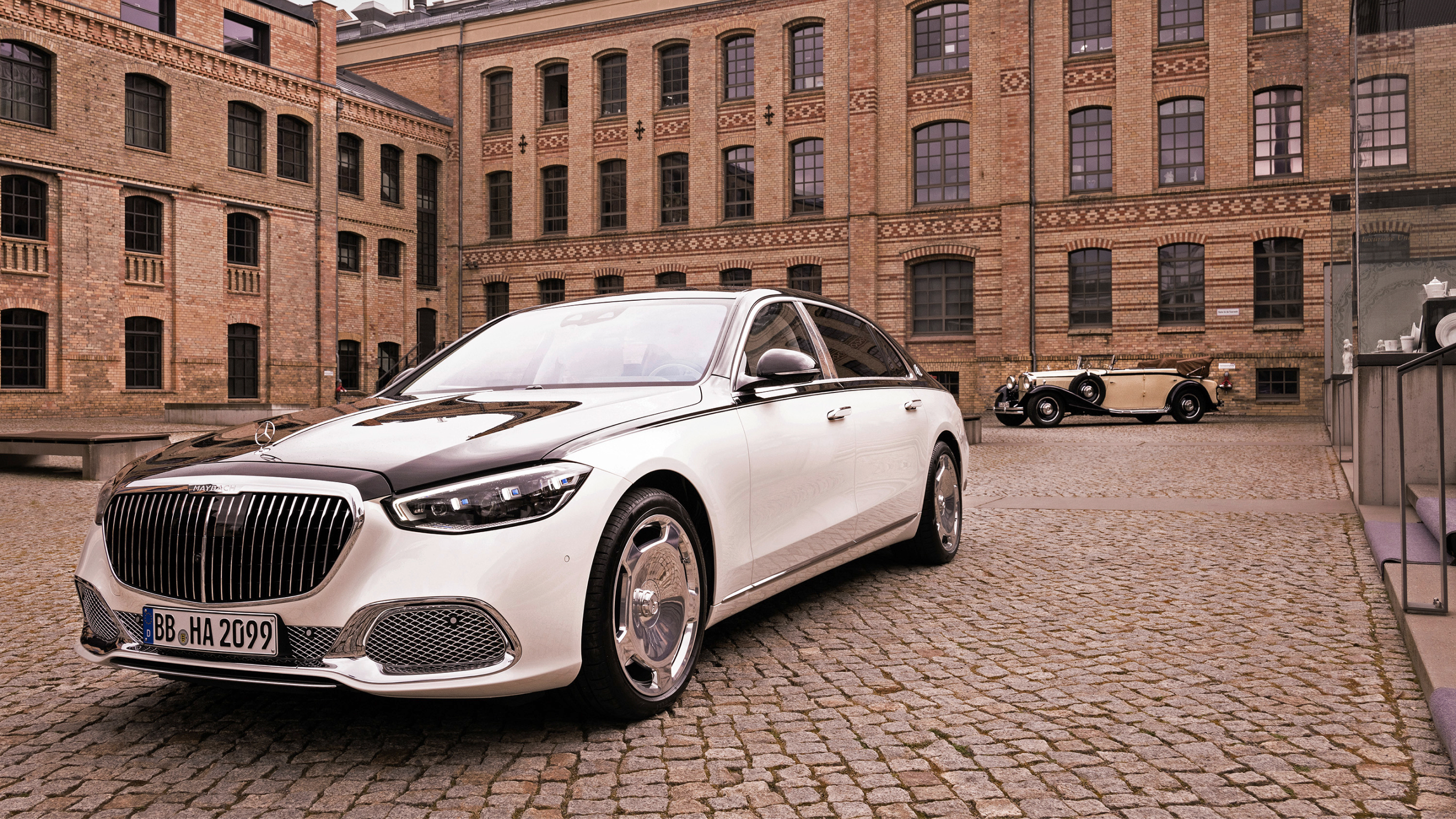
The name Maybach has been synonymous with luxury for a century. Image: Mercedes-Benz AG/Benjamin Zibner.
;Resize=(828,828) "Mercedes-Maybach S-Class 2021")
100 years of Maybach motorcars.
The history of the Maybach brand has been closely tied to Mercedes-Benz since its founding in 1921. The common goal: driving luxury vehicles to new heights.
16 December 2021
Throughout its 100-year history, the name Maybach has been synonymous with luxury. To celebrate this milestone, we look back at how the brand has pushed the barriers of innovation and design in passenger vehicles, both before and after its association with Mercedes-Benz began.
Luxury and high-tech
With their elongated silhouette measuring a total length of 5.47 metres, striking radiator grille and wide C-pillar with triangular windows, Mercedes-Maybach saloons have always represented the height of sophistication. The 3.4m wheelbase was designed to create an opulent interior feel, while the wide range of technological, media and visual features result in a relaxed combination of luxury and high-tech. A wide range of high-end materials are available for owners to customise the vehicle, along with expansive options to personalise how the vehicle is operated.
The Mercedes-Maybach GLS, still new on the scene, is an SUV that combines the technological basis of the GLS with the haute couture of a Maybach. The result is a vehicle with impressive credentials in both design and construction innovation – which is entirely in keeping with Maybach’s heritage.
Pioneers of modern mobility
Before Wilhelm Maybach, his son Karl and energetic inventor Count Ferdinand von Zeppelin started constructing their own vehicles under the Maybach brand, Wilhelm Maybach developed the lightweight, fast-running combustion engine along with Gottlieb Daimler.
The first modern car was constructed at a customer’s request in 1900 and 1901. Its abiding construction principles included the long chassis, front-mounted engine and the “honeycomb” radiator grille, which provided for a sporty engine performance – and which characterises the construction of car cooling units to this day.
From 1907, Wilhelm also started designing large engines together with his son, Karl. These innovations gave momentum to an emerging trend: aviation.
Pioneering airship builder Count von Zeppelin became part of a joint venture that manufactured Maybach engines for Zeppelin airships from 1912 onwards, from a base in Friedrichshafen in the south of Germany. The airships’ quietly hovering flight provided a new perspective on the world, and resulted in an exquisite way to travel: weightlessly gliding from place to place in a cosy cabin with every conceivable comfort for passengers.
After World War I, the company transferred its talents into automobile engineering, and the Zeppelin name became associated with land-based travel.
Moving history
From 1930, selected top-of-the-range Maybach models were given the ‘Zeppelin’ title.
The DS 8 Zeppelin, which came onto the market in the early 1930s, towered over many vehicles with its eight-litre engine featuring 12 cylinders and eight-gear transmission. Its mohair and crystal interior emanated a sense of worldly elegance.
Karl Maybach’s own official car was built onto a chassis from the 1930s in 1957. It was the last official Maybach made in Friedrichshafen before Daimler-Benz acquired a majority stake in 1960, along with the rights to the brand.
From 2002 to 2013, a new series featuring the 57 and 57 S or 62 and 62 S drew on the tradition of the Zeppelin. Developed and designed under the leadership of Mercedes-Benz, Maybach was established as its own car brand. In 2014 with the Mercedes-Maybach S 600 Pullman, Maybach once again moved closer to the brand with the star.
Under the auspices of Mercedes-Benz, Mercedes-Maybach was now dedicated exclusively to maximum luxury. The S 600 Pullman is a direct reference to the Type 600, also known as the ‘Big Mercedes’, which was produced from 1963 to 1981. The brand’s most luxurious model offered everything that engineers and stylists could produce in terms of technology and luxury.
Visions for the future
Two show cars were presented in 2016 and 2017 under the name Vision Mercedes-Maybach 6, with the 5.7m length making impressive design options possible.
With the highly elongated bonnet, low roofline and ‘boat tail’ rear reminiscent of the decks of luxury yachts also made from elm, the Vision Mercedes-Maybach 6 set a new direction in style. Fittingly, the elegant droplet shape of the Vision Mercedes-Maybach 6 was influenced by the art deco period – the early 20th century, back when the first Maybach vehicles found their way to their new owners.
The brand recently gave an insight into the future with the presentation of the Concept Mercedes-Maybach EQS; the SUV will be the first all-electric mass-produced Mercedes-Maybach model.
The debut of the Mercedes-Maybach models in 2021 not only meets the brand’s high standards of excellence with the EQS SUV study, it also marries its impressive heritage with a sophistication it will carry into the future. It is exactly this vibrant history that will continue to make Maybach such a compelling proposition in the market.
Learn more about the all new Mercedes-Maybach S-Class here.
This article was originally published in Mercedes me magazine and has been edited for clarity.
By Thomas Giesefeld