Explore
How a classic soft-top came back to life.
24 May 2022
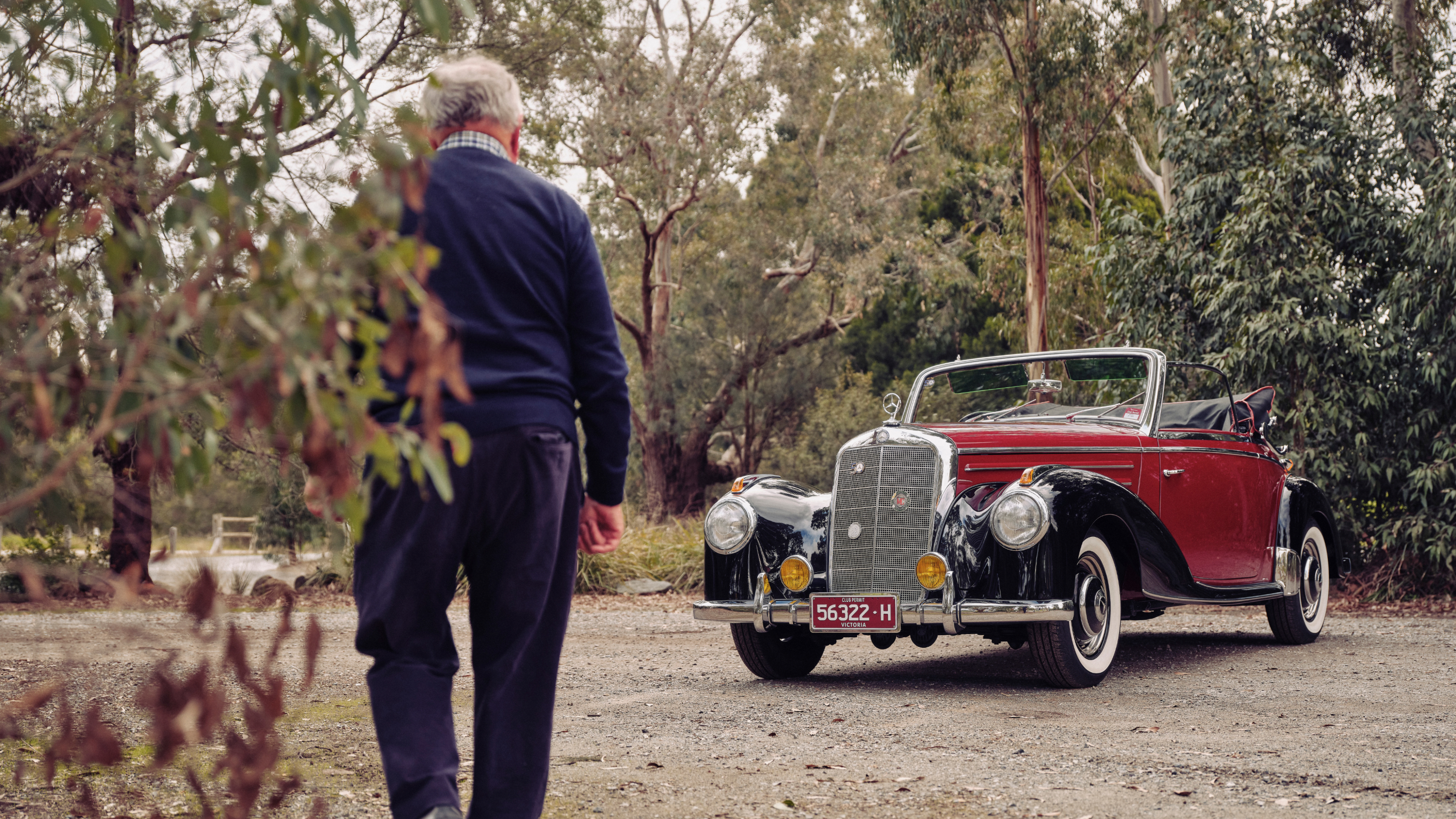
Restoring a 1952 220A Cabriolet from a box of parts was a labour of love for lifelong Mercedes-Benz enthusiast Murray Allen. Discover how our classic convertible stole his heart.
;Resize=(828,828) "Murray Allen")
Restoring a 1952 220A Cabriolet from a box of parts was a labour of love for lifelong Mercedes-Benz enthusiast Murray Allen. Discover how our classic convertible stole his heart.
24 May 2022
Explore
24 May 2022
Restoring a 1952 220A Cabriolet from a box of parts was a labour of love for lifelong Mercedes-Benz enthusiast Murray Allen. Discover how our classic convertible stole his heart.
Looking at the immaculate 1952 Mercedes-Benz 220A Cabriolet Roadster that takes pride of place in a compact suburban Melbourne workshop, It’s hard to believe it came into Murray Allen’s possession as a trailer-load of “kicked-around bits”.
The classic soft-top in striking two-tone paintwork looks as fresh as the day it left the Stuttgart factory, some 70 years ago, en route to America where it was purchased in New York City.
It now sits alongside a collection of four other Mercedes-Benz vehicles that Murray has lovingly restored to near-showroom specification. Next door, a small room brims with Mercedes-Benz posters, books, photos and vehicle manuals that he has collected over seven decades.
A lifelong love
The restoration of the 220A, part of the Mercedes-Benz W 187 model family, was completed in 2005, one year after Murray’s retirement. It was a painstaking process that took five years and called for inspiration, advice and parts from all over the world.
It may be the now 82-year-old’s final full restoration project, and if public opinion is anything to go by, it could be his best. At a German Auto Show held in Melbourne in February, the curvaceous beauty received the People’s Choice Award.
Even more than that, though, it stands as a loving tribute to the three-pointed star that has brought fascination and joy to Murray’s life since he discovered the automotive section of his local library as a schoolboy.
“They had some excellent pre-war books on Mercedes-Benz history. And at age 12, I appreciated that they were a good piece of work, and that stuck with me,” he says.
Assisting his father in performing restorations on Vauxhalls and Hillmans fanned the flames of his automotive fixation. Later becoming qualified as a fitter and turner and then as a toolmaker, he had the skills, but not yet the means to indulge his passion.
Progressing to working in the refrigerated shipping container industry, Murray’s success in a rapidly expanding sector allowed him to set up a more comfortable life for his family.
It also created the means to finally acquire a 1974 W 123, the forerunner to today’s E-Class. Since then, a succession of E-Class models has exclusively graced his driveway – until now. At the time of writing, his E 220 daily driver was being traded on a brand-new, fully optioned A-Class sedan. “It was time to downsize,” he says wistfully.
The golden age
Yet Murray’s truest love for the brand remains rooted in its past, especially the gentle curves that defined graceful models emerging from Stuttgart from the mid-1950s to the early ’60s.
His first restoration project was a “Roundy”, the affectionate name given to the 1960 190B ‘Ponton’. That was followed by a 1960 220SE Coupe, then a 1956 300B ‘Adenauer’ Limousine, a vehicle that has since served as the wedding vehicle for each of Murray’s three children. Putting an exclamation point on the collection is a 1960 190 SL, a sports coupe regarded as one of the brand’s most iconic models.
Throughout each project, Murray has been an active member of the Mercedes-Benz Club Victoria for 35 years. He also served a stint as club president, affording him opportunities to attend meetings at Mercedes-Benz headquarters in Stuttgart attended by club presidents from around the world.
This extensive network gave Murray access to the knowledge and assistance required to transform a rusty body shell and an assortment of parts into a showpiece worth far more than the $18,000 he paid for it.
“My wife said, ‘you're mad’ and I said, ‘no, no, we can make a good car out of that’. The base was there. There's only a handful of them in Australia,” Murray says.
“When this came up, it was pretty hard to say but there was probably three to five years of heavy work in it. I looked at it and I figured that within 10 years it would be worth a lot more.
“So, I kept that in the back of my mind and never skimped on bodywork, mechanics or anything. I did the best job I could do with my own hands or using contractors all the way through.”
There are examples of this craftsmanship everywhere you look, from the softly sprung seats covered in rich leather upholstery to the gleaming red-and-black paintwork that was applied by a specialist in South Australia. Yet this was no open cheque book exercise.
“It was always a careful spend, knowing that you would get your money back at the end of the day,” Murray says, adding he has no intention of selling the 220A in his lifetime. It’s unlikely his wife and three adult children, all Mercedes-Benz club members and owners themselves, would even attempt to overrule him on that point.
From left to right
The 220A came into Murray’s possession as a left-hand drive vehicle, and the repositioning of the steering wheel on the right-hand-side is the main departure from its original specification.
For such a major structural alteration, this proved surprisingly straightforward. The preceding model, the 170, was built in both left- and right-hand drive variations and shared the same steering componentry, which he was able to source and retrofit to the 220A.
More problematic was locating the original radio unit that dominates the centre of the dashboard. A chance discovery by a friend attending a swap meet in Turkey proved the stroke of luck he needed.
Mostly, though, in an era before internet commerce and Google searching had really taken off, the pursuit of parts and information involved some fairly dogged detective work.
“I used the experience from four previous restorations plus a lot of writing and reading, and finding people overseas who have done a similar thing,” Murray says.
“There was a lot of ringing blokes at two in the morning. It was good mental exercise. A lot of them have come back to me in turn, looking for information about their next project. I’ve got friends all over the world – some amazing people.”
A powerful ally
Another challenge was to fill the remaining gaps in his knowledge about the 220A. Here, a powerful ally came to the rescue. “You can work from photos and old drawings, but you've got to go and see one,” Murray says.
“[Businessman] Lindsay Fox has one on his collection, so I got in touch with the staff at his museum and they couldn’t have been more helpful, giving me access to his car and answering as many of my questions as they could.”
Whilst some parts were sourced intact from around the world, many had to be fabricated locally using shop drawings, photos and illustrations. “It's a logistical challenge to put it all together and find the right suppliers,” he says.
“While you're waiting for a bit to come from America, someone local is also machining something for you, or a foundry is casting something such as the indicators.
“You had these older tradespeople for whom time is not a problem, when you really wanted it next week. So you had to play it fairly carefully.”
On the question of whether the 220A is his final project, Murray isn’t unequivocally ready to call time yet. “I think I have probably done enough, and with grandkids I don't have as much time,” he says.
“But sometimes you get a bit bored, or you go to a show and see a bloke who's done a restoration and he's two years older and you think 'there's still hope yet'. You never know when an opportunity will come around the corner.”
By Steve Colquhoun