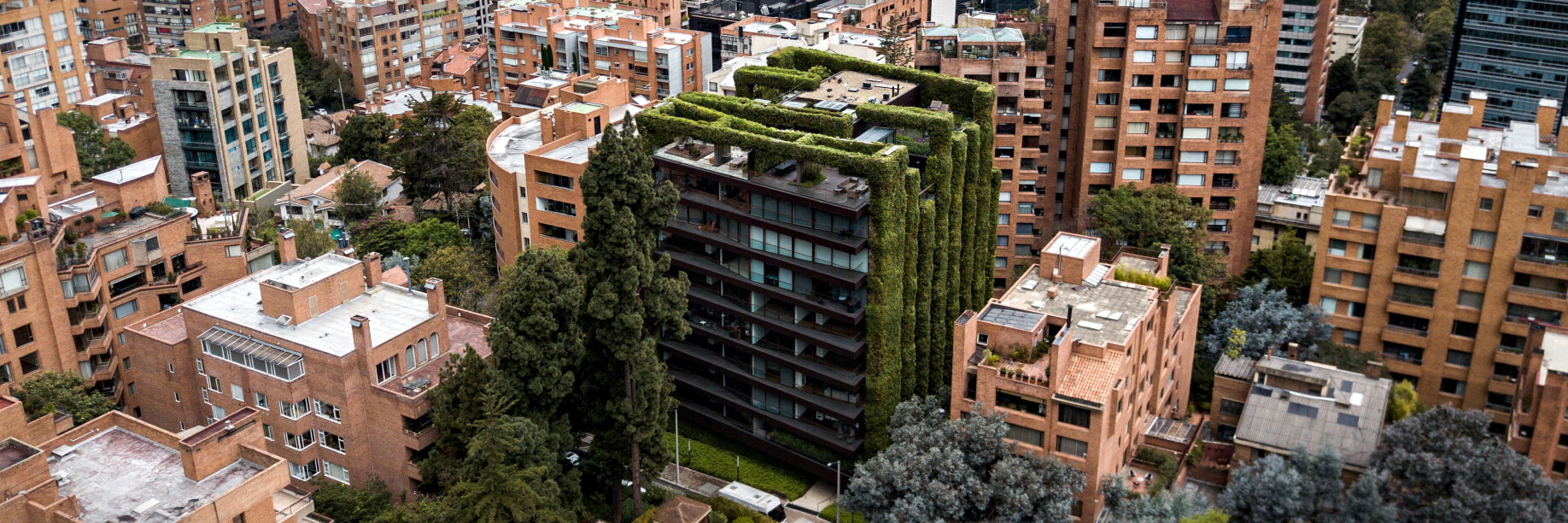
This building in a densely populated residential district in Bogotá is adorned with around 115,000 plants that purify the air. Image: Supplied.
;Resize=(828,828) "Biophilic design in Bogota")
Bringing the outdoors in: the rise of biophilic design.
Through biophilic design, architects are doing incredible things to make us more connected with nature.
20 October 2020
Nature can be very healing. You feel the effects as soon as you step into a forest: your heartbeat slows down, and your breathing deepens. A Japanese therapy known as shinrin-yoku (literally: forest bathing) is taking over the Western world, and since its rise to prominence, multiple studies have proven that surrounding yourself with nature increases creativity, extends periods of concentration and strengthens the immune system.
It’s no wonder, then, that urbanites frequently yearn for more nature in their lives. After all, it can be hard to come by within the confines of city life. And yet most cities have done little to address this.
“The demand for organic architecture goes back over a century,” says New York-based architect Mitchell Joachim. “But cities are made of concrete, steel and glass.”
Joachim doesn’t often stop for breath when he talks about his job as an architect and about his passion for nature, but in this case, he takes a moment to reflect. “Organic construction”, he says, “has been possible for a few years. The technology has finally caught up.”
A bit of greenery does wonders for the climate
Biophilic building, biophilic design: for Joachim, this concept is more than just an architectural fad. Incorporating nature into every nook and cranny in the city is the only conceivable – indeed, the only reasonable – approach. Not just because it makes ecological sense, but because being in the presence of nature lets us slow down and become more aware of our surroundings. It enables us to be kinder to ourselves and those around us, creating a better climate in every sense of the word.
It doesn’t take a whole forest to do this. In 2015, researchers in Canada discovered that when streets were lined with trees in densely populated residential areas, residents were healthier overall. People need nature. Especially in the city, where residents spend most of their time behind closed doors.
But green living is beginning to establish itself there, as well. In fact, it’s taking root everywhere from New York to Berlin to Buenos Aires, from train stations to urban areas, indoors and outdoors.
Architect Stefano Boeri has incorporated 900 trees into the two residential towers that form his spectacular “Bosco Verti cale” – or “vertical forest” – project. The forested facade absorbs over 30 tonnes of carbon dioxide and 80 kilograms of particulates every year while cooling the interior by three degrees.
The power of an urban oasis
This shift can be witnessed at a much smaller scale as well: small flower meadows can be found at over 300 bus stops in the Dutch city of Utrecht. Utrechters endearingly refer to these as “bee stops”.
It’s no coincidence that Tatiana Bilbao from Mexico City was awarded the Marcus Prize for architecture. As an architect, she is committed to sustainable living solutions that meet people’s needs. Nature plays a leading role in her innovative concepts. For example, she recently designed a holiday home in Monterrey, Mexico, with mirrored glass that reflects the surrounding trees. This allows the home to essentially merge with the forest.
Mitchell Joachim’s Terreform One consultancy is inspired by the credo “design with life”. His architects work with engineers and biologists to develop visionary urban solutions. They construct homes within trees, create benches from fungal spores and grow walls in laboratories. Joachim envisions a world where cities, people and nature exist in perfect harmony. In other words: maximum sustainability.
A multi-storey building with a butterfly garden built into the facade is currently in the works. The idea came to Joachim when he heard about how monarch butterflies – those stunningly beautiful butterflies with vibrant orange and black wings – are dying off. “We’ve lost billions of monarch butterflies in recent years, despite New York being their home. The city has become their enemy, so we want to give them their own environment in Manhattan.”
This article was originally written and published for Mercedes-Benz Group AG.
By Iris Mydlach