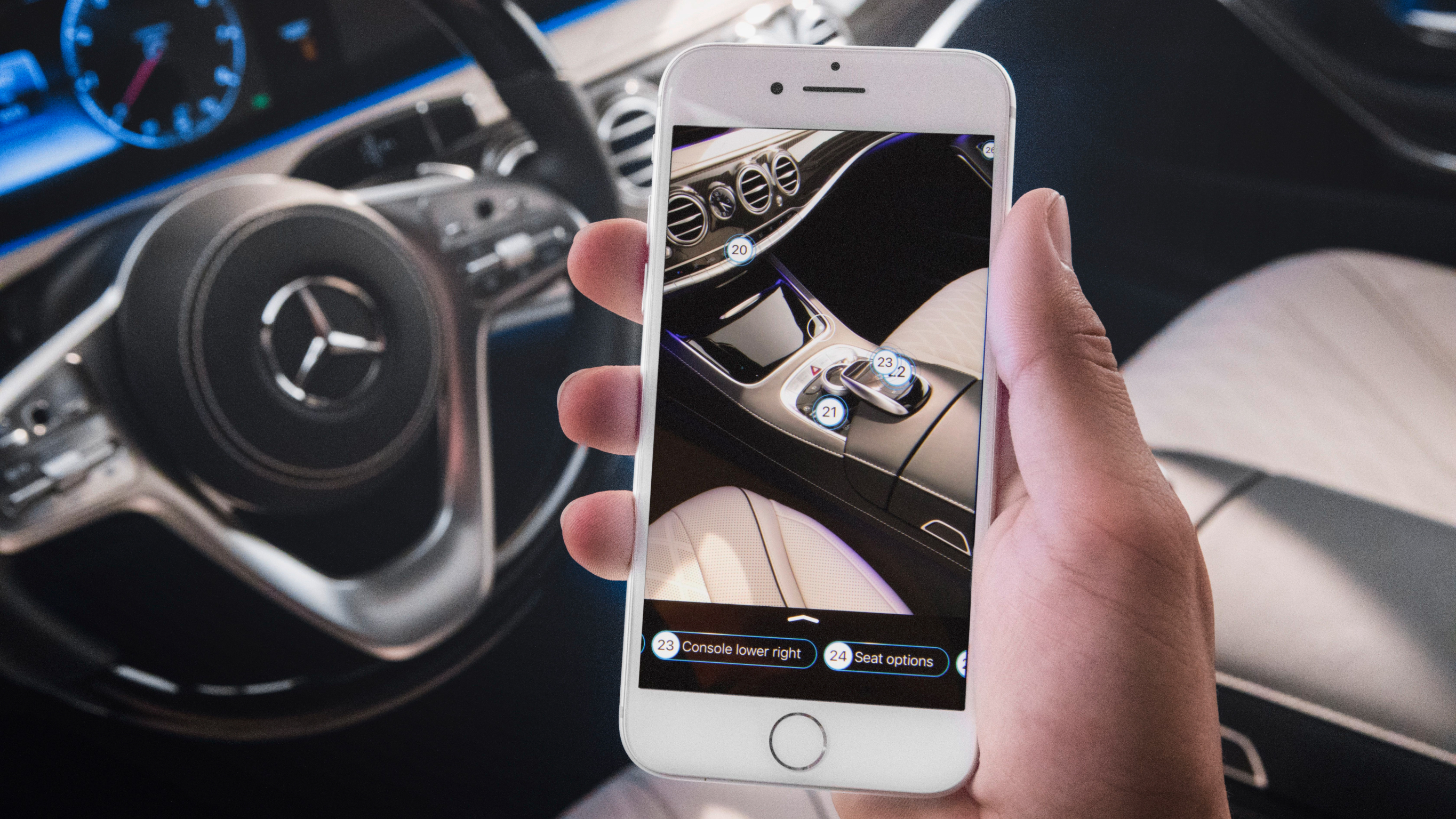
Ask Mercedes is a downloadable app that uses your phone’s camera to recognise controls in select Mercedes-Benz models and act as a virtual instruction manual. Image: Daimler.
;Resize=(828,828) "AskMercedes")
Are you ready to augment your reality?
Unlike virtual reality, augmented reality enhances your real-world view. Here’s how this innovative technology is coming to life in Mercedes-Benz vehicles.
19 October 2020
Augmented Reality (AR) sounds like technology from somewhere in the future; you don’t really understand what it means, but you’re excited that someday you’ll find out.
Well, today is that day. We’ll explain not only how it works and what it can do to help you, but also how AR technology is already being utilised in Mercedes-Benz vehicles.
First things first – how does Augmented Reality differ from Virtual Reality? VR, as you might already know from movies and computer games, presents an alternate virtual world. A fully immersive experience, often using goggles or a headset that specifically excludes real-world sights and sounds.
AR, as the name suggests, augments your real-world view, enriching it with data or graphics. If you’ve ever played Pokémon Go – in which fictitious computer animations roam the real-world streets when viewed through an app overlaying your phone camera – you’ve already experienced AR. Apps that superimpose digital features onto a photo subject are another example.
You might also recall Google’s failed attempt a few years ago to introduce AR into our lives – ‘Google Glass’ was supposed to assist our lives with a trove of data superimposed onto the glass lens in front of our very eyes. But the technology was not mature, and it failed to become the next must-have gadget – for now.
Yet AR is finding plenty of other real-world applications. One type is where you point your phone camera at an object or a view, and an explanation – text or voice – adds another layer of understanding to what you are seeing. This is useful for sightseeing apps, in which the app correlates location data with image recognition to identify a landmark, prompting a detailed explanation.
By Steve Colquhoun