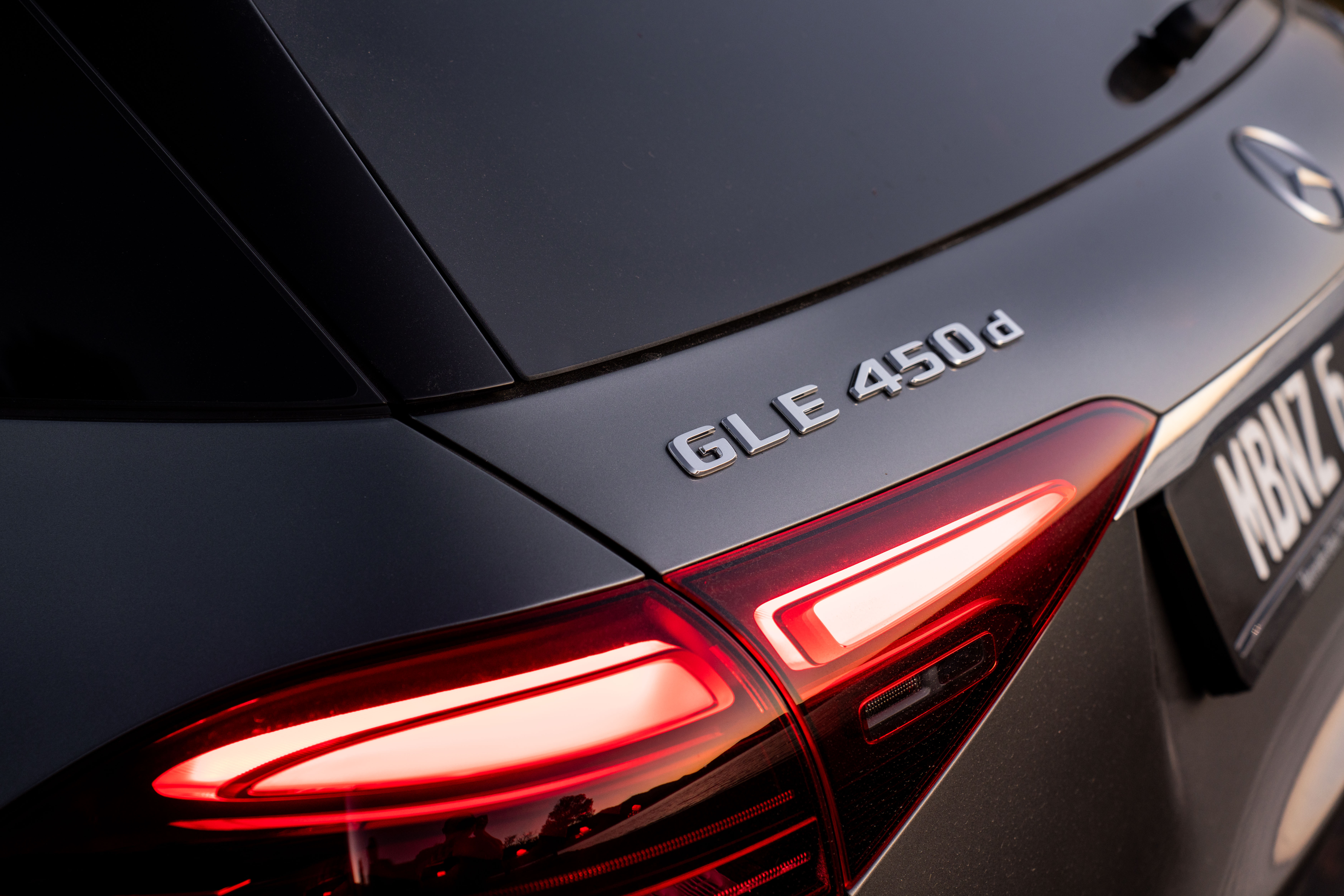
;Resize=(828,829) "A close-up of the badge of a Mercedes-Benz GLE 450 d.")
From A-Class hatchbacks to high-performance SUVs, the Mercedes-Benz range has never been broader. With so many models, it’s important to understand the naming system so you can quickly identify where each vehicle sits in the line-up.
What does the number in a Mercedes-Benz model name actually mean? Is it connected to engine size? And what do letters like ‘e’, ‘d’ or ‘4MATIC’ represent?
While today’s naming system is more flexible than it once was, there’s still a clear logic behind it. Here’s a straightforward guide to decoding our vehicle names and numbers.
First, start with the letter in the vehicle model
The easiest way to understand a Mercedes-Benz model is to start with the letter. Traditionally, the letters identify the vehicle family, body style or position within the Mercedes-Benz range.
For example:
• A-Class: Our compact hatchback and sedan models.
• C-Class: A mid-size sedan with a sporty exterior.
• E-Class: Executive-focused models with more interior room and technical features.
• S-Class: Our flagship sedan.
• GLA, GLC, GLE, GLS and G: The SUV range spanning compact to full-size models, through to our off-road icon.
• CLE: A two-door coupé and cabriolet range.
• SL: A premium open-top roadster.
SUVs generally use the ‘G’ prefix, followed by a letter(s) that aligns them with the equivalent passenger-car range. For example, the Mercedes-Benz GLC SUV sits alongside the Mercedes-Benz C-Class, while the Mercedes-Benz GLE SUV aligns more closely with the Mercedes-Benz E-Class.
If you want a more detailed breakdown of the different types of Mercedes-Benz models, see our complete guide to the letter series and our electric cars.
Next up: what do the numbers mean?
At times in the past, Mercedes-Benz model numbers closely reflected engine size. A badge such as ‘300’ typically referred to a 3.0-litre engine, while ‘500’ identified a 5.0-litre V8. Modern powertrains are far more complex, however. Turbocharging, hybrid systems and electrification mean engine output no longer directly corresponds to displacement.
Today, Mercedes-Benz model numbers are better understood as performance indicators within the range rather than precise measurements of engine size. The larger the number, the higher the performance or level of luxury generally becomes. Depending on the model, this could also mean added comfort features, extra appointments, premium equipment levels, increased driver assistance or enhanced ride and handling capabilities.
For example, the C 200 produces 150kW from its internal combustion engine and 17kW from its electric motor, while the C 300 produces 190kW and 17kW respectively. The C 300 also has a slightly higher top speed and includes features such as the Burmester® 3D surround sound system as standard (an optional extra on the C 200).
There is still some relationship between the number on the badge and engine size. A smaller number typically denotes smaller engine output:
• The C 200 is typically powered by a turbocharged four-cylinder petrol engine.
• The E 300 generally uses a more powerful four-cylinder petrol drivetrain.
• The GLE 450 commonly features a turbocharged inline six-cylinder engine.
• Mercedes-AMG models may use high-performance four-cylinder, six-cylinder or V8 powertrains depending on the vehicle.
Hybrid technology has also changed the game. Many Mercedes-Benz vehicles combine combustion engines with integrated electric assistance for improved efficiency and performance. Plug-in hybrid variants add larger battery systems capable of driving longer distances using electric power alone.
What does the number in a Mercedes-Benz model name actually mean? Is it connected to engine size? And what do letters like ‘e’, ‘d’ or ‘4MATIC’ represent?
While today’s naming system is more flexible than it once was, there’s still a clear logic behind it. Here’s a straightforward guide to decoding our vehicle names and numbers.
First, start with the letter in the vehicle model
The easiest way to understand a Mercedes-Benz model is to start with the letter. Traditionally, the letters identify the vehicle family, body style or position within the Mercedes-Benz range.
For example:
• A-Class: Our compact hatchback and sedan models.
• C-Class: A mid-size sedan with a sporty exterior.
• E-Class: Executive-focused models with more interior room and technical features.
• S-Class: Our flagship sedan.
• GLA, GLC, GLE, GLS and G: The SUV range spanning compact to full-size models, through to our off-road icon.
• CLE: A two-door coupé and cabriolet range.
• SL: A premium open-top roadster.
SUVs generally use the ‘G’ prefix, followed by a letter(s) that aligns them with the equivalent passenger-car range. For example, the Mercedes-Benz GLC SUV sits alongside the Mercedes-Benz C-Class, while the Mercedes-Benz GLE SUV aligns more closely with the Mercedes-Benz E-Class.
If you want a more detailed breakdown of the different types of Mercedes-Benz models, see our complete guide to the letter series and our electric cars.
Next up: what do the numbers mean?
At times in the past, Mercedes-Benz model numbers closely reflected engine size. A badge such as ‘300’ typically referred to a 3.0-litre engine, while ‘500’ identified a 5.0-litre V8. Modern powertrains are far more complex, however. Turbocharging, hybrid systems and electrification mean engine output no longer directly corresponds to displacement.
Today, Mercedes-Benz model numbers are better understood as performance indicators within the range rather than precise measurements of engine size. The larger the number, the higher the performance or level of luxury generally becomes. Depending on the model, this could also mean added comfort features, extra appointments, premium equipment levels, increased driver assistance or enhanced ride and handling capabilities.
For example, the C 200 produces 150kW from its internal combustion engine and 17kW from its electric motor, while the C 300 produces 190kW and 17kW respectively. The C 300 also has a slightly higher top speed and includes features such as the Burmester® 3D surround sound system as standard (an optional extra on the C 200).
There is still some relationship between the number on the badge and engine size. A smaller number typically denotes smaller engine output:
• The C 200 is typically powered by a turbocharged four-cylinder petrol engine.
• The E 300 generally uses a more powerful four-cylinder petrol drivetrain.
• The GLE 450 commonly features a turbocharged inline six-cylinder engine.
• Mercedes-AMG models may use high-performance four-cylinder, six-cylinder or V8 powertrains depending on the vehicle.
Hybrid technology has also changed the game. Many Mercedes-Benz vehicles combine combustion engines with integrated electric assistance for improved efficiency and performance. Plug-in hybrid variants add larger battery systems capable of driving longer distances using electric power alone.