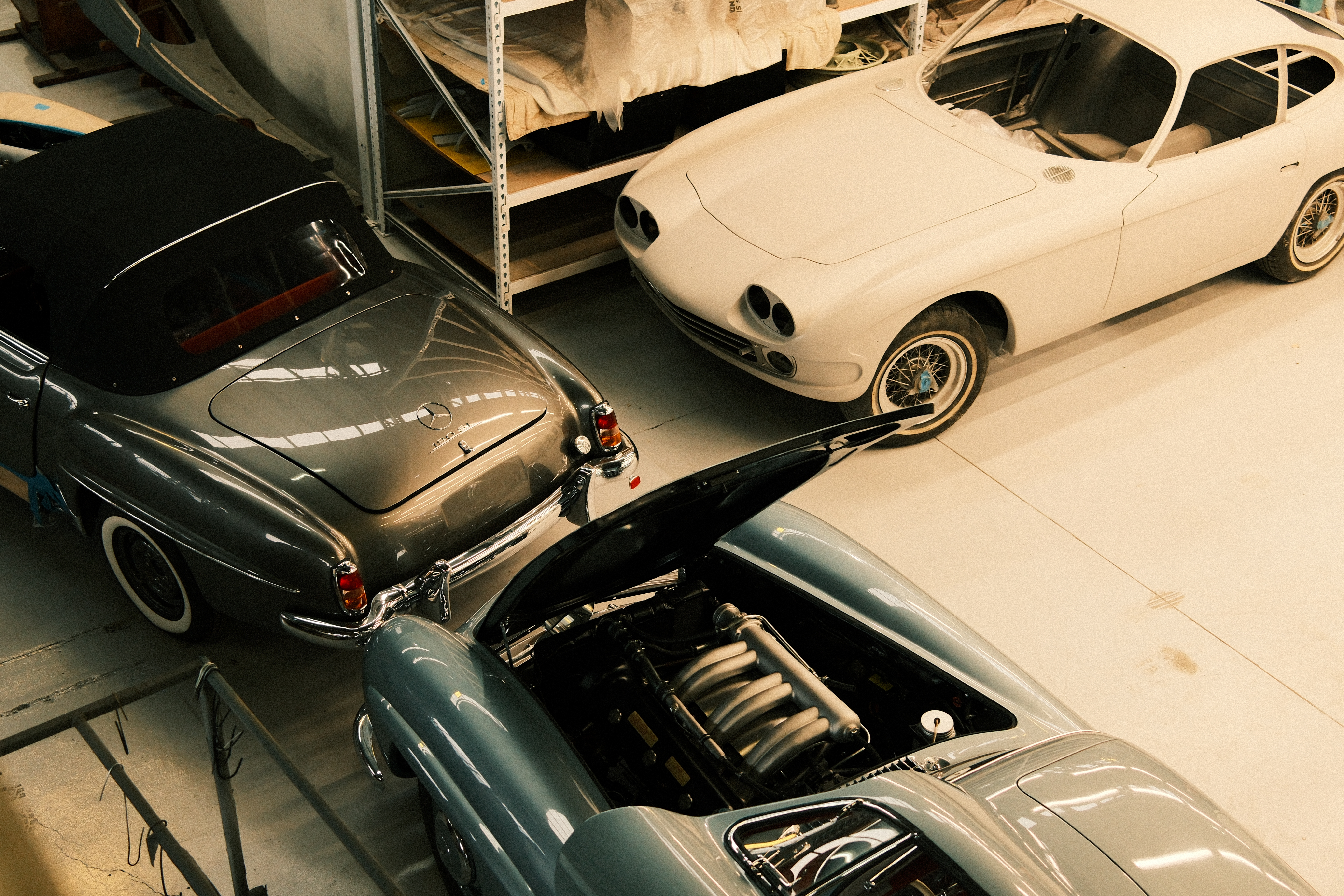
;Resize=(828,829) "Three classic Mercedes-Benz cars at the Sleeping Beauties workshop in Brisbane.")
“The best or nothing”: the workshop reviving rare cars.
Sleeping Beauties is Australia’s only fully
in-house classic car restoration workshop.
We step inside the Brisbane-based workshop to
meet the craftspeople bringing icons like
the Mercedes-Benz 300 SL ‘Gullwing’ back to life.
July 2026
“The cars we typically focus on are pre-1970, and Mercedes-Benz was the best car in the world by some mile at that point.”
Hailed by the press at the time as the "car of the world elites" and as a "model for what can be achieved today in automobile construction”, 560 examples of the 300 S were built between 1952 and 1958 – 216 coupes, 203 Cabriolet As and 141 roadsters – and it cost US$12,680 in 1953. Owners included Cary Grant and the Aga Khan, while the example restored by Sleeping Beauties was originally bought by Argentinian President Juan Perón for his wife, Evita.
In 2000, the team also completed the restoration of a stunning 1924 Benz 11/40 Tourer, which now resides at Mercedes-Benz Australia’s headquarters in Melbourne.
The allure of a classic car collection
For those wishing to embark on their own restoration project, James urges caution.
“We normally talk people out of doing restorations because it’s the wrong car,” he explains. “It’s obviously a very costly process and to do a full restoration can cost up to the high hundreds of thousands of dollars. “When it comes to something that’s sentimental, it’s totally up to the beholder, but a lot of the time, the best way to go for restoration is to come to us with an idea of what sort of car they want to do. We will then guide them into which one and try and find them a car, because it’s very easy to buy a project which may cost twice as much as another one.”
Just as with the restoration itself, planning and preparation are everything. If you’re going to spend that much time and money bringing a classic Mercedes-Benz back to its former glory, you might as well have the best.