The electric vehicle (EV) may seem like a recent technological advancement in the field of transport, but it’s been around a lot longer than you think.


The first primitive battery-powered vehicles emerged in the late 19th century and were able to travel extremely short distances before the batteries died and were simply disposed of. It wasn’t long before innovators began exploring the concept of rechargeable batteries – Thomas Edison is credited with building one of the earliest electric vehicle charging stations at his home in New Jersey in 1908.


Modern-day electric vehicles, such as those in the Mercedes-EQ range, are powered by high-performance lithium-ion batteries that can be recharged using several different methods, whether you’re at home or on the road.


How are electric vehicles charged?


EV batteries are charged using either alternating current (AC) or direct current (DC) electricity. While electricity from the grid is delivered as AC, present-day battery systems will only accept DC electricity, which is why all EVs have an AC/DC rectifier on board to convert AC power to DC.

EV batteries are charged using either alternating current (AC) or direct current (DC) electricity.

There are three levels of EV charging available:


Level 1

This is AC charging delivered via a standard 240V domestic wall socket using a cable that is supplied with most EVs. It looks a bit like an extension cord, but one end connects with the vehicle’s charging port. Level 1 can deliver an estimate of 2.4 kW to 3.7 kW of power at approximately 10 to 15 amps, although charging output can vary depending on environmental and infrastructure factors such as outside temperature – cold weather can mean battery charging will take slightly longer


Level 2

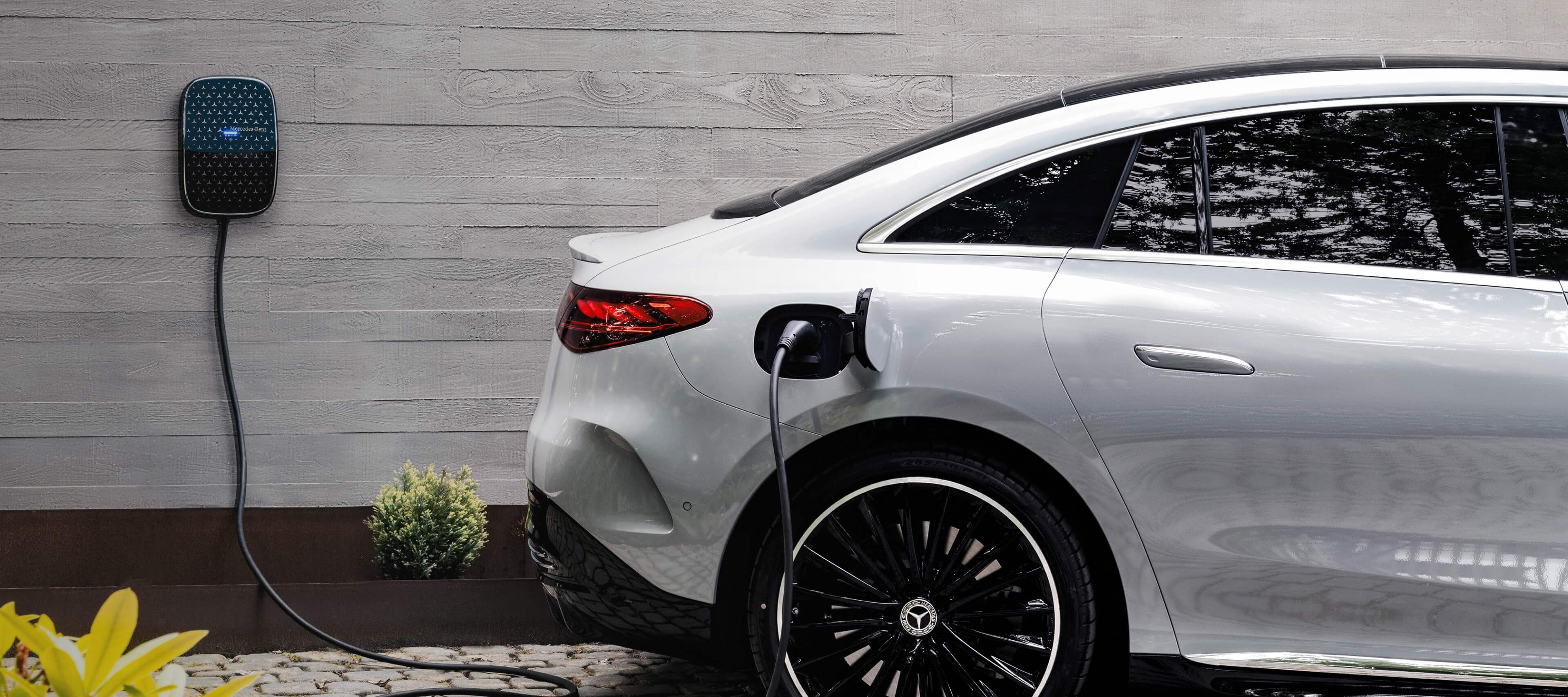
A dedicated EV wall charger such as the Mercedes-Benz Wallbox will take things up a notch. The Mercedes-Benz Wallbox can deliver an adjustable charging capacity of up to 7.2kW for single phase power and 22kW for three phase power.


Keep in mind, the Mercedes-Benz Wallbox must be installed by a qualified electrician. Level 2 charging may also be achieved at public AC charging stations, which are typically found in car parks and at shopping centres.


Level 3

This is high-voltage DC charging, usually only accessible via public fast chargers that convert electricity from AC to DC, so your EV’s AC/DC rectifier doesn’t have to. DC fast chargers can offer an estimated charging capacity between 25 kW and 350 kW in Australia (and up to 300 kW in New Zealand) and is known at “ultra-rapid” or “hyper-rapid” charging. 


How long does it take to charge an electric vehicle?


Logic dictates that the bigger the battery pack in an EV, the longer it will take to charge, but it actually depends on a number of variables, such as the charging level you opt for. Battery charging speeds can vary depending on the model of electric vehicle, environmental and infrastructure factors. Estimates for the range and time required for charging at levels 1, 2 and 3 are provided by the Electric Vehicle Council of Australia.

How many public EV charging stations are there in Australia?


According to the Electric Vehicle Council’s State of Electric Vehicles 2022 report, there were 1,580 standard AC and 291 DC fast-charging stations located around Australia as of March this year. The report suggests that we could see an additional 700 fast chargers over the next five years, thanks to increased government support for public electric vehicle infrastructure.


How far can you travel on a full charge?


The answer to this question largely depends on the electric vehicle and the size of its battery. In the current Mercedes-EQ range of all-electric vehicles, the compact EQA has a battery capacity of 66.5 kWh and offers a range of up to 400km, while the slightly larger EQB offers a range of between 445km and 507km depending on the variant. The mid-size EQC SUV can take you up to 430km on a full charge, while the top-of-the-range Mercedes-AMG EQS 53 has an indicative driving range of around 500km.


More models will be joining the Mercedes-EQ family soon, including the EQS SUV and the EQE sedan.  And if the Mercedes-Benz VISION EQXX concept car is anything to go by, we could be seeing electric vehicles with even greater ranges in the not-so-distant future.

Discover the range of electric vehicles from Mercedes-EQ.


By Stephen Corby

Discover more from the world of Mercedes-Benz.