Image: Thomas Wieleck.
;Resize=(828,828) "Drive Day")
Driving the evolution of automotive safety features.
From airbags to ABS, Mercedes-Benz has long led the field of automotive innovations that keep us safe on the road. So, what does the future hold?
29 June 2021
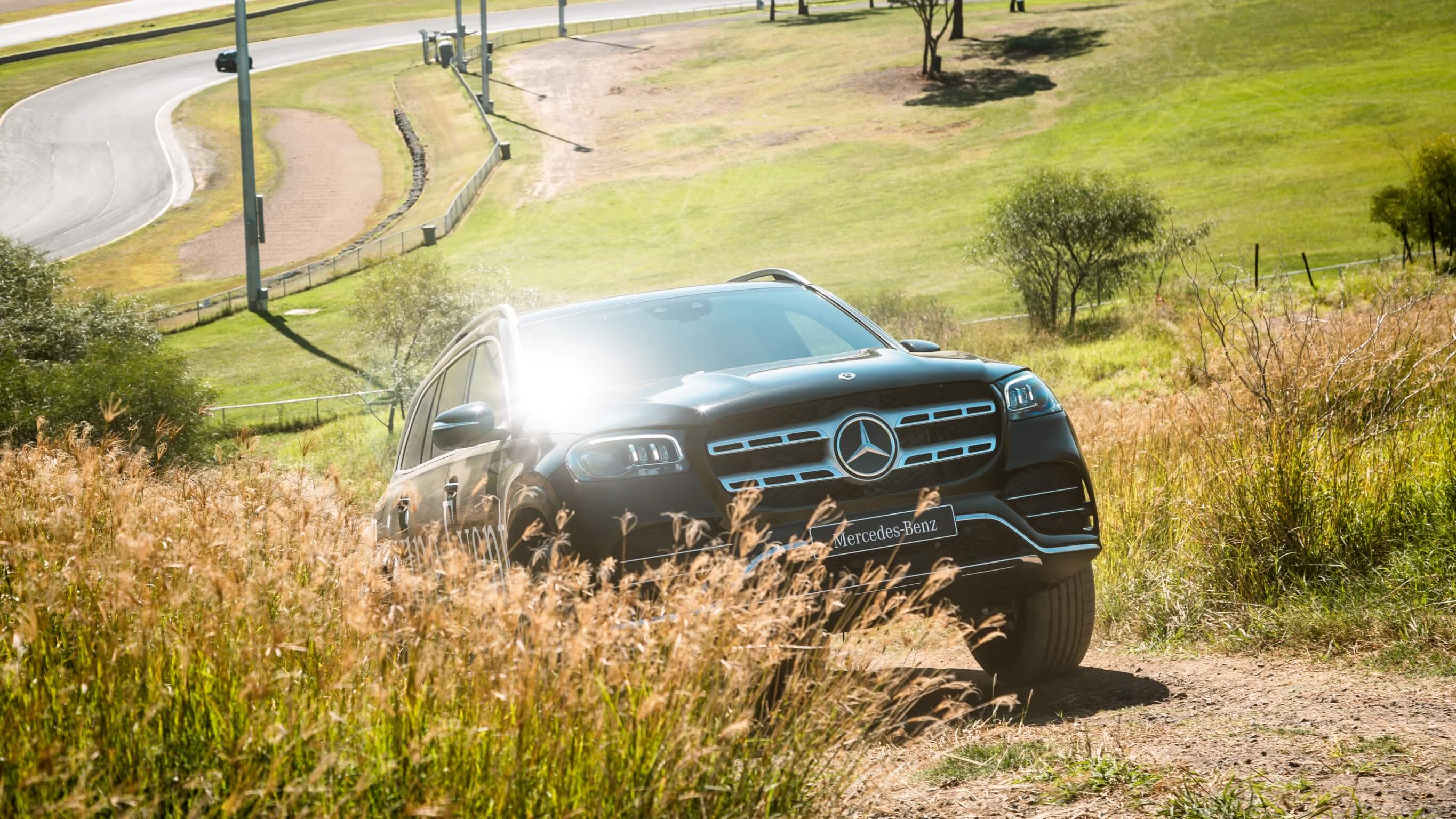
It’s a crisp autumn morning at Sydney Motorsport Park and I’ve already skidded in an E 300 sedan, emergency-braked and swerved in a GLA 250 4MATIC, made mincemeat of a rugged off-road track in a GLS 400D, and taken corners at speeds I ordinarily wouldn’t reach on the straight in an AMG GT R. So far, so much fun …
We’re being put through our paces by a crack team of instructors at Mercedes-Benz Accelerate, a driving event designed to improve our skills and showcase the range and capabilities of the Mercedes-Benz stable of vehicles. It’s also an insight into the advances in automotive safety that lie at the heart of this venerable German brand.
An enduring legacy
The origins of Mercedes-Benz safety development go back to the company’s inception by automotive pioneers Karl Benz and Gottlieb Daimler in 1926. Official records at the then Daimler-Benz AG company don’t start until the 1930s. Since then, Mercedes-Benz has documented all its innovations, starting with the concept of ‘passive safety’.
Passive safety systems are automotive design and technical features that protect people against the effects of an accident. Mercedes-Benz brought this concept to life in 1959 with the launch of its W111 luxury saloon, featuring a safety-enhanced body from which the term ‘crumple zone’ was coined. The W111 also utilised the concept of a ‘disarmed’ interior by reducing the number of hard or sharp controls and introduced wedge-pin door locks with two safety catches, setting the standard of passive safety for a generation of vehicles.
In the ensuing decades, Mercedes-Benz has been at the forefront of passive safety innovation, including the introduction of safety steering columns and, most important, airbags, whose development started in 1966 and was patented five years later. In 1981, Mercedes-Benz introduced a driver’s airbag as an option in its flagship S-Class series 126, and it was swiftly embraced by the global auto industry.
Side-by-side with passive safety, Mercedes-Benz introduced ‘active safety’, which continues to evolve to change the way we drive and survive. Active safety describes the use of supportive systems that intervene to avoid, or limit the severity, of an accident. The anti-lock braking (ABS) system is an example of your vehicle actively keeping you safe and was introduced for the first time in a W116 S-Class in 1978. Integrated with the Electronic Stability Program (ESP), input from the ABS sensors is also used to stabilise the car when cornering, being over- or under-steered, or skidding.
Along the way, Mercedes-Benz pioneered the use of systematic crash tests (1959), the analysis of actual accidents (1969), and the invention of the automatic rollover bar (1989). In fact, over the course of his 30-plus years as head of the newly minted department for safety development, engineer Béla Barényi registered some 2500 patents, mostly involving vehicle-safety innovations.
It is he, along with development executive Hans Scherenberg, who came up with the concept of integrating active and passive safety into automotive development in 1966, an approach that informs Mercedes-Benz’s integral design standards to this day.
Moving forward
Mercedes-Benz remains a driving force in vehicle-safety innovation, with new features regularly introduced into its latest vehicles, no matter their category level. This safety-first approach to development was recently recognised by the Australasian New Car Assessment Program (ANCAP), which named 10 Mercedes-Benz models in its top 13 best-scoring cars for child occupant protection in 2021. Witnessing these features in action at the Accelerate event is a masterclass in ingenuity.
Take the seventh generation of the S-Class, for example. Its Augmented Reality head-up display with an optional AI unit offers real-time navigational data, whereby directional arrows appear to guide you to the road or lane you need to take. The voice-activated MBUX also allows you to keep your eyes on the road (and your fingers off the screen!) while the latest generation of Driver Assistance Technology displays the safety system in operation on your screen.
Pivotal to these advancements is the standard Active Distance Assist DISTRONIC, a system that constantly gauges the driving conditions ahead with the aid of a radar in the front bumper and a stereo camera at the top of the windscreen, enabling you to ‘set and forget’ your speed limit, while it automatically monitors your distance from the car in front.
Add the Mercedes-Benz Driving Assistance Package and the technological ingenuity ramps up several notches:
• Active Speed Limit Assist monitors speed-limit signage and adjusts the car’s speed accordingly without you using the accelerator or brake.
• Active Stop and Go Assist brings the car to a halt and holds for up to 30 seconds before moving on – great for stop-start traffic conditions.
• Route Based Speed Control uses GPS data to gauge and execute the requisite speed to safely negotiate any given road condition – a roundabout, for instance.
• Active Steering Assist uses all the car’s data to watch the white lines on the road. Leave your hands off the wheel for too long and the car will automatically slow and stop, the screen will warn you, and the hazard lights will start flashing to warn other vehicles around you. In the event of a health emergency, this could save lives. It even phones emergency services.
• Active Lane Change Assist ensures safe overtaking by using all the radars, cameras and GPS data to execute an autonomous lane change.
• Evasive Steering Assist enables the car to swerve around an obstacle by turning the steering wheel just enough for you to avoid it, before countering the wheel direction at the same ratio to put you back on course.
• Active Lane Keeping Assist uses the same technology as Active Steering Assist by keeping the car in lane and stopping ‘drift’. Veer too far, and that warning ‘rumble’ will turn into a manoeuvre that eases you back into your lane.
• Active Blind Spot Assist uses sensors in the back of the car to check blind spots. If you indicate and there’s a vehicle approaching, a red triangle flashes in your wing mirror accompanied by a warning sound.
• Pre-Safe Plus – if you’re stuck in a motorway tailback or waiting at a junction and a car crashes into the back of you, prior to impact, the car’s hazard lights will activate, and your seat will move into the safest position, while contracting the seatbelts to ‘hug’ you and your passengers to minimise potential injury.
Active Brake Assist is standard on all new Mercedes-Benz passenger cars, but combined with these other features, it makes the system more intelligent, even detecting pedestrians and cross traffic – something ably demonstrated by our track day exploits in the GLE 400D.
And the future? Well, with the kind of technological advances we’re witnessing now, it shouldn’t be too long before Mercedes-Benz is able to take driving out of our hands completely. Safer perhaps, but let’s hope it’ll be as much fun as a day on the race track.
A brief history of safety breakthroughs at Mercedes-Benz
1939: Engineer Béla Barényi takes over the Department for Safety Development; registers more than 2500 patents between 1939 and 1972, mostly for innovations in vehicle safety.
1956: Individual vehicle components are tested for their response in an accident with acceleration carriages.
1958: Mercedes-Benz offers seat belts for all vehicles with individual front seats, but seat belts don’t become mandatory in Germany until 1976.
1959: Systematic crash tests begin, using complete vehicles pioneered at the Mercedes-Benz Sindelfingen plant.
1966: The allocation of ‘active’ and ‘passive’ vehicle safety is designed by Barényi and new development executive Hans Scherenberg. Airbag development begins.
1969: The accident research department starts analysing and reconstructing findings from actual traffic accidents.
1970s: The company collaborates in global research projects for vehicle safety, including the Experimental Safety Vehicles (ESV) program. Research vehicles are created under the name Experimental-Sicherheitsfahrzeug (ESF).
1971: Airbag patent is registered.
1974: Based on the S-Class of the 116 model series, the ESF 24 tests passive safety innovations including belt force limiters and airbags.
1981: The S-Class 126 model series features airbags.
1987: The front-passenger airbag enters the world stage in S-Class saloons and coupés.
1989: The SL 129 model series features seats with integral seat-belt anchorage and automatically triggered rollover bar.
1994: Béla Barényi inducted into the Automotive Hall of Fame in Dearborn, Michigan, USA, for his ground-breaking work in vehicle safety.
1998: The window, or side airbag becomes standard in all models.
2000s: Passive and active safety coalesce into the Mercedes-Benz concept of ‘integral safety’, particularly in intuitive and intelligent technologies that comprise its ‘Intelligent Drive’ concept. Multiple airbags become standard, including rear-seat knee and belt airbags and thorax/pelvis side airbags.
By Sally Feldman