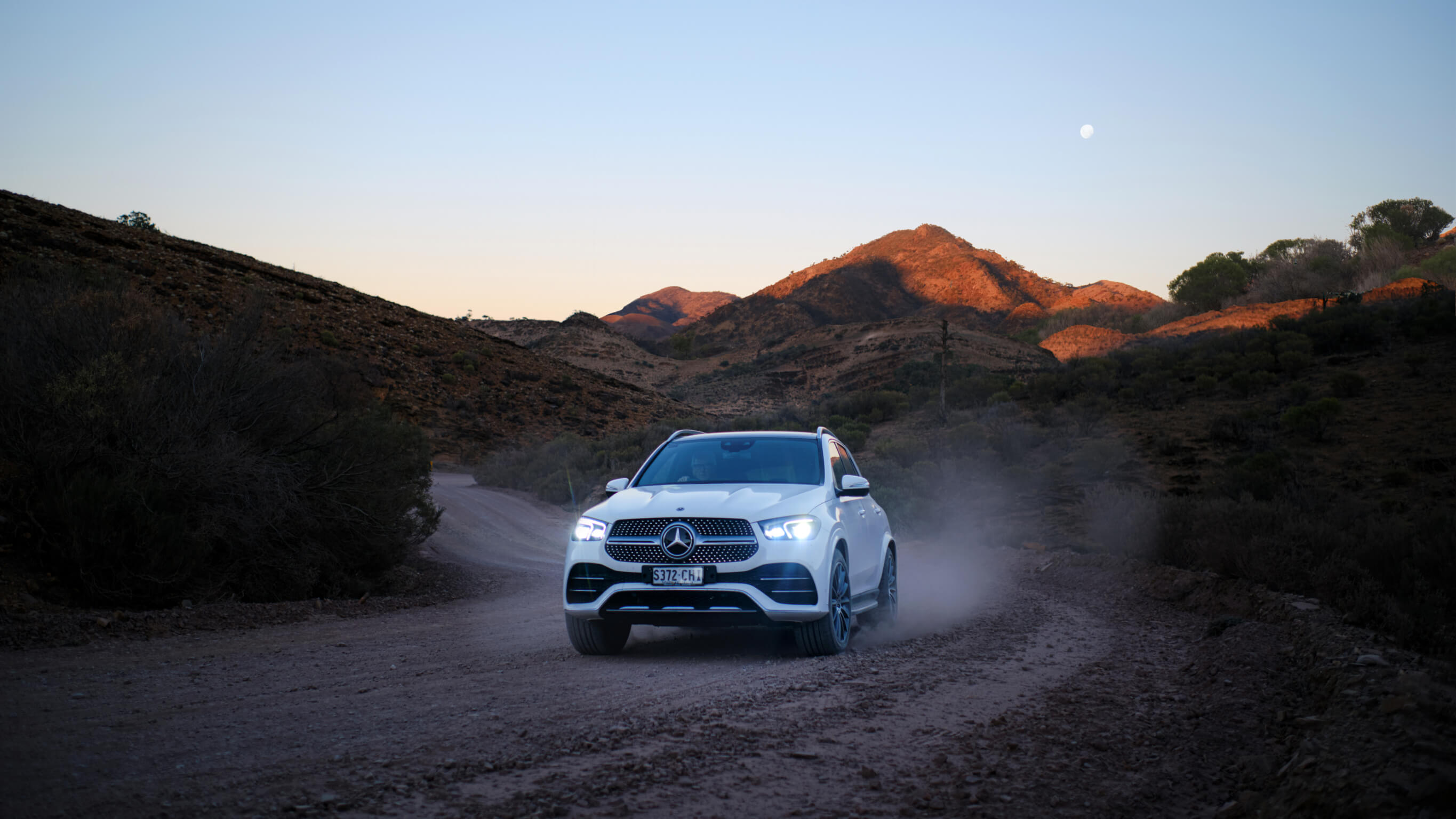
Photographer Gary Heery embarked on an expedition through South Australia’s rugged Flinders Ranges in the Mercedes-Benz GLE 350. Image: Gary Heery.
;Resize=(828,828) "GaryHeery1")
Touring the Flinders Ranges with photographer Gary Heery.
South Australia’s rugged terrain sets the scene for this former celebrity portrait photographer who now turns his lens on the natural world and the creatures flying through it.
28 June 2021
“I’ve always been enchanted by beauty, and I find nature to be electrifyingly beautiful. I get a little bit awe-inspired by it.”
Sydney-based photographer Gary Heery is famous for capturing some of pop culture’s most iconic figures (Andy Warhol, Madonna and Cate Blanchett, to name a few). But it’s portraits of a slightly wilder variety that currently dominate his artistic practice.
“I’m not as interested in celebrity anymore,” he explains of his shift towards the great outdoors. “I’m into the natural world now.” And it’s here, amidst the semi-arid landscapes and rocky gorges of South Australia’s Flinders Ranges, that Gary is looking to feed a decade-long creative obsession: birdlife.
“Those little critters,” he laughs. “Honestly, I’ve been photographing birds for 10 years, and they’re just magical, colourful, beautiful things, aren’t they?”
This passion for feathered subjects first manifested in his 2015 photographic publication, Bird, and served as the basis for a solo exhibition, Birdscape, at the Olsen Gallery in Sydney earlier this year. “I’m a portrait photographer, I’m not a wildlife photographer. But I want to keep growing all the time, you know. I want to go where I haven’t been.”
Gary’s forthcoming exhibition, which will be an extension of the acclaimed Birdscape series, took him to the Ranges to explore the spectacular terrain in a Mercedes-Benz GLE 350. “I must say, we were going to places where I was a bit worried about getting a flat tyre. But it’s been a dream,” he says of the trip.
“We went to Parachilna and stayed at the hotel there. We’d be shooting every morning at 4 am or 5 am, and then would go back in the evening when the light was really perfect,” he recalls.
The as-yet-unnamed exhibition, which opens at the Olsen Gallery in February 2022, will feature birds alongside arresting landscapes and flora. “I love the desert, and in my new series I’m including succulents and orchids. I’m fascinated by plants as well.”
Unlike the majority of wildlife photography, which is shot using a long lens camera, Gary takes a portrait approach, electing to capture his subjects in a more intimate manner. “Close and personal, because it drags you into the photograph more,” he explains. His shots, developed on archival pigment print, are surreally sharp. A flock of lorikeets immortalised mid-flight, for example, seem to wear human-like expressions of recognition. He describes this style as “idealised”.
“Everything’s photographed, right? Everything’s done in-camera, but then some things are manipulated [throughout],” he explains. “When I say ‘idealised’, it means that I’m making you look at something in a very different way. You go, ‘How the hell did he do that?’.”
“That’s my job now – as a photographer and a fine arts photographer – to create a provocative image. So, what looks to appear to be completely a one-shot, in-camera [take] is, in fact, much more than that.”
While Gary is precise in his digital manipulation and use of texture and montage, he rarely knows what he is setting out to photograph until he stumbles upon it. It’s a serendipitous attitude that’s shaped much of his varied career over the last 50 years. “When you’re young, you have to be really adventurous, otherwise nothing ever happens,” he says. “So, I took a lot of big chances early on.”
After experimenting with photography in his university days he travelled to Papua New Guinea on a whim, learning darkroom tricks of the trade from a friend who had an obsession with Irving Penn. Another invitation to travel soon followed, this time to Tulsa, Oklahoma, where he co-founded the magazine Indian American, which he likens to a National Geographic.
On to Los Angeles, where a chance meeting with high-profile record cover photographer Norman Seef landed him an assistant position on the spot. Within hours, he found himself working on the shoot for an album cover for Ike and Tina Turner, a moment he cites as the definitive start of his career. “All of a sudden I’m doing record covers and I’m doing my own thing. I’ve got a studio in LA and I’m living the life,” he recalls.
Gary returned to Australia in 1987, where he carved out a name for himself locally in fashion and advertising, before aiming his lens at other personally gratifying subjects. “I do projects for charity that are quite rewarding, in terms of portraiture and raising money. I’ve been involved with Wayside Chapel over the years, and I do projects with underprivileged kids,” he says.
“I choose now to be more generous with myself about things. Like this new Birdscape and landscape series I’m working on – when you look at it, you do a double take, don’t you? You go, ‘Oh, look at that, it’s so beautiful’.
“It’s like a love affair,” he muses. “If you really love something and you find it really attractive, then it’s worth pursuing, isn’t it?”
By Victoria Pearson