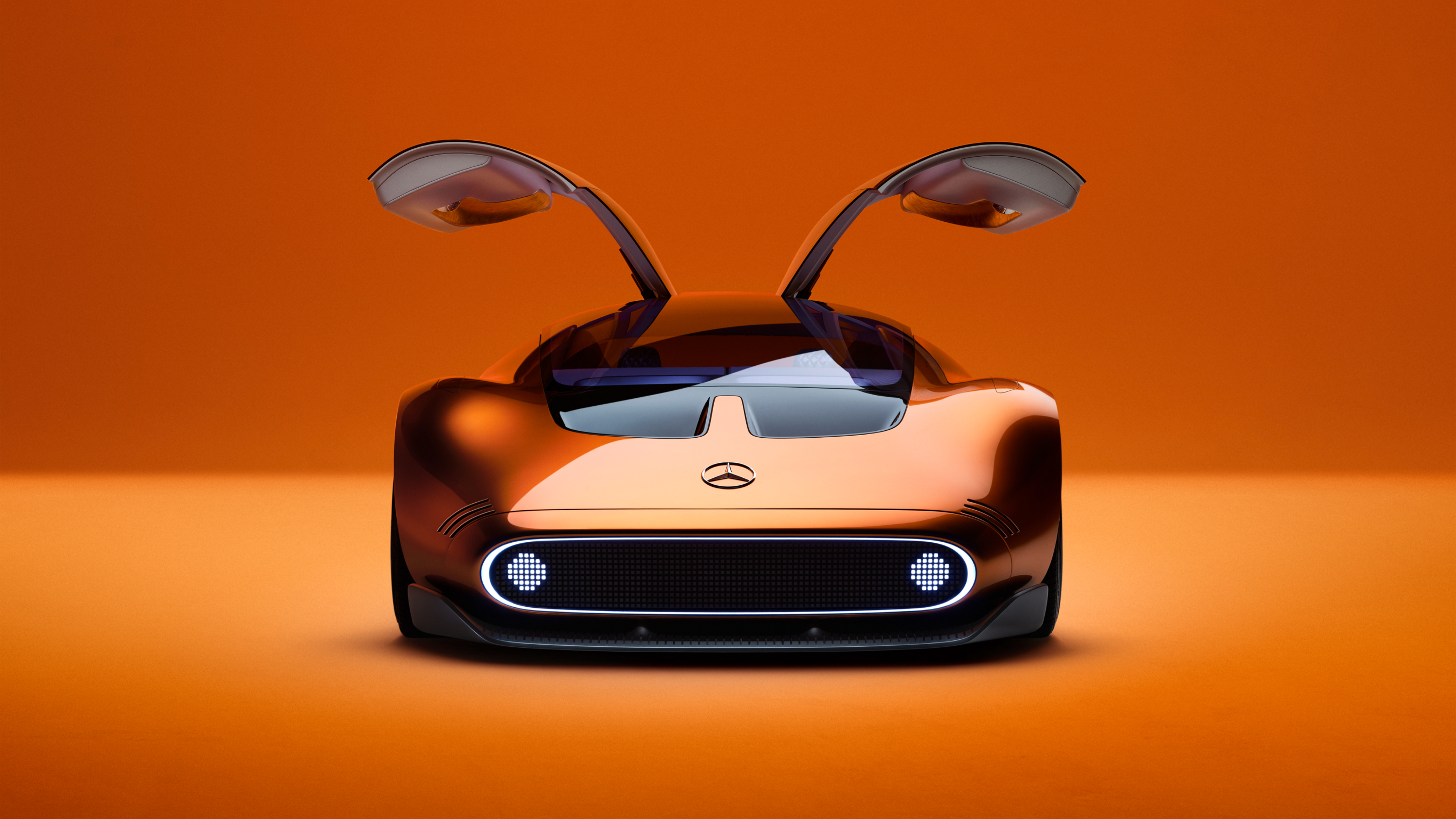
“To me, that makes the difference between mainstream design and luxury. Design icons like the 300 SL and C 111 – both with gullwing doors – are part of our DNA. These legendary vehicles were major inspirations for the iconic design of the Vision One-Eleven… our all-electric show car is the modern-day interpretation of the C 111. The element of surprise comes from its exceptionally clean, purist and, at the same time, extremely muscular proportions.


“We also like simplicity, which is harder to achieve than complexity,” Wagener says. “The surfaces on the Vision One-Eleven trigger your buttons instantly.”

Ahead of its time


The original 1969 C 111 was revealed as an ‘experimental sports car’, developed to test various engineering ideas now referenced in the Vision One-Eleven. The orange and black colour scheme was perhaps the most evocative element of the car’s design, along with the head- and tail-light treatment.


The C 111 changed the face of Mercedes-Benz design. Clean, elegant and aerodynamically efficient, its beautiful, timeless style proves the car was more than just an experiment. No doubt the late Rudolf Uhlenhaut – a development engineer for Mercedes-Benz – set out to build the world’s best sports car.


The C 111 was to be a modern 300 SL, a mid-engine gullwing supercar to rival all others in both performance and appearance, combining these qualities with typically Teutonic practicality and superior handling and roadholding.


The original 206kW three-rotary car was impressive, but it was the 1970 275kW four-rotary car that brought a huge performance increase. With a top speed of 285km/h, and an acceleration of 0-100km/h in 4.8 seconds, it was truly brilliant for the era. Combined with its lower waistline, larger windows, and gullwing doors, the C 111 had around 500 people queuing up with their cheque books open at the time – hoping to get their hands on a production version.

“The car’s captivating one-bow design showcases a seamless blend of muscular lines and elegant curves.”

The wheels are huge for a concept car, their design inspired by the motor windings used in the One-Eleven’s powertrain. Instead of a grille, the One-Eleven's front end features an oval panel with pixelated LEDs that mimic the C 111's fog lights and can display messages. A similar panel is found on the rear end, while a pixelated pattern appears on the opaque windows – a feature seen on other Mercedes-Benz concepts like the Vision AMG.


Inside, a pared-back User Interface, oblong aluminium steering wheel, concealed driving mode buttons and small touchscreen play with the ‘lounge’ concept that fully autonomous cars promise to deliver. But the full-length pixelated dashboard is anything but understated, capable of displaying information in ultra-sharp QR code form like a news ticker. Complementing the shiny silver seats are dials, switches and accelerator and brake pedals finished with polished aluminium – lending the Vision One-Eleven a truly futuristic look.


I spent a day hustling the original C 111 on the challenging roads to the south-east of Stuttgart – it’s a wonderful, essentially modern, car. I wonder if there’s a chance to drive the Vision One-Eleven in similar circumstances.

Discover the Vision One-Eleven here.

By Peter Robinson

Discover more from the world of Mercedes-Benz.