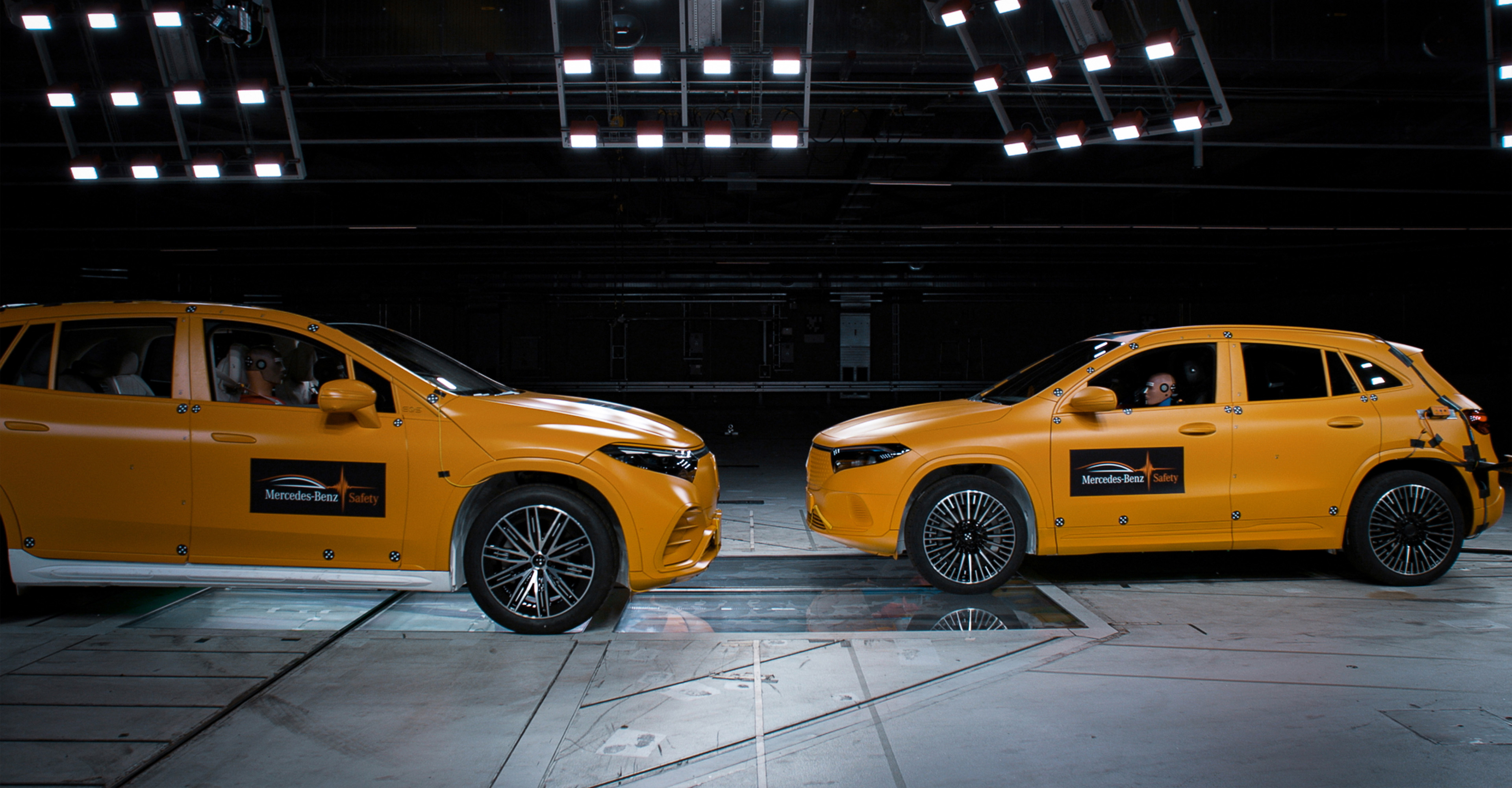
When it comes to vehicle safety, Mercedes-Benz has always been a pioneer. For decades, our in-house accident research has paved the way toward more efficient and effective safety systems and technologies – many of which have been adopted by other car manufacturers. Now, having completed the world’s first public crash test involving two all-electric vehicles, we continue to set new standards.


Conducted at our state-of-the-art technology centre for vehicle safety in Sindelfingen, Germany, the world-first public test involved our all-electric Mercedes-Benz EQA SUV and Mercedes-Benz EQS SUV. It far exceeded minimum legal requirements as well as those of independent bodies such as Euro NCAP.


“Safety is part of Mercedes-Benz’s DNA and one of our core commitments to all road users,” says Markus Schäfer, member of the board of management and chief technology officer of Mercedes-Benz Group AG.


“And to us, protecting human lives is not a question of drive system. The recent crash test involving two fully electric vehicles demonstrates this. It proves that all our vehicles have an equally high level of safety, no matter what technology drives them.”


Real-life safety


For more than 50 years, ‘real-life safety’ has been a core part of our safety philosophy. Going above and beyond regulations and requirements, our in-house accident research experts study real accidents, using this knowledge to assess new safety technologies and build vehicles that offer effective on-road protection.


The recent crash test was no different, replicating a real accident that might take place on the road.

“Safety is part of Mercedes-Benz’s DNA and one of our core commitments to all road users,” says Markus.

Consider that the Euro NCAP frontal impact test uses a 1400kg trolley with an aluminium honeycomb barrier to replicate the front of another vehicle. The test vehicle strikes this barrier at 50km/h with a 50 per cent frontal offset. The Mercedes-Benz test, on the other hand, used two real-world vehicles – an EQA and EQS SUV – both of which are significantly heavier (weighing approximately 2.2 and three tonnes respectively). Using a 50 per cent overlap impact, the two vehicles collided head-on at a speed of 56km/h.


With its greater mass and higher speed, the Mercedes-Benz test generated significantly more energy compared to the Euro NCAP frontal impact test.


Both vehicles effectively absorbed the energy of the collision by deforming along carefully engineered pathways. This controlled transfer of energy resulted in the passenger safety cells of both models remaining intact, and the doors could still be opened – making it possible for occupants to exit the vehicle in the event of a collision.

Crash test dummies


The EQA and EQS SUV used in the test were fitted with four adult crash test dummies: one male and three females. Dr. Hanna Paul, head of dummy technology at Mercedes-Benz AG, explained that the brand is leading the industry with the use of female dummies.


“We have been using female dummies at Mercedes-Benz for more than 20 years,” she says. “However, they are not human dolls, but measuring instruments. In designing the measuring equipment, the weight and size of the dummy genders are derived from real-life human data, with the female dummy corresponding to female anatomy.”


The use of a fifth percentile female dummy (representing a 150cm tall, 49kg female) and a 50th percentile male dummy (representing a 175 cm tall, 78kg male) ensures that the safety systems and crash structures in Mercedes-Benz vehicles are designed for a broad cross-section of occupants.


Each high-tech crash test dummy is fitted with numerous sensors, offering up to 150 data points. Analysis of this data after the crash test indicated a low risk of serious to fatal injury. This data, along with examination of both the EQA and EQS SUV, demonstrated that the advanced restraint systems and designated crumble zones offer occupants very good protection potential in an impact of this severity.

“The recent crash test… proves that all our vehicles have an equally high level of safety, no matter what technology drives them.”

Holistic protection


During impact, the high-voltage electrical systems in the EQA and EQS SUV automatically switched off as part of the multi-stage protection system that has been developed for all-electric Mercedes-Benz vehicles. The system has been designed to ensure the safety of the lithium-ion battery and all components with a voltage of above 60 volts.


Further analysis of this real-world test showed that all safety systems – airbags and seat belt tensioners with belt-force limiters – worked as intended and as shown in numerous computer simulations.


Of course, like all Mercedes-Benz vehicles, the EQA and EQS SUV are fitted with a suite of active safety features to help avoid an accident in the first instance. In addition to side airbags for rear-seat passengers and knee airbags for the driver, the EQA SUV also boasts Active Distance Assist DISTRONIC and Blind Spot Assist – a feature that uses radar sensors to detect nearby vehicles and adjust vehicle speed to ensure a safe distance. The EQS SUV adds PRE-SAFE, which triggers a host of measures to protect you prior to a collision, and PRE-SAFE Impulse Side, which moves the front seat occupant's upper body towards the centre of the vehicle and away from the door when an imminent side impact is detected. And for added peace of mind, GUARD 360° anti-theft protection[1] (which is available as standard for the EQS SUV) gives your vehicle extra security and helps you locate it if stolen.


Safety Symphony


The groundbreaking crash test of the EQA and EQS SUV now forms the bedrock of a new film known as ‘Safety Symphony’. The film expands and distils the dramatic split-second event into an informative documentary that includes behind-the-scenes analysis and super slow-motion video of the impact.

When viewed in super slow motion, it’s possible to understand and appreciate the coordination and harmony of the integrated safety systems as they deploy and work in classical symphony to protect life.


The real-world crash test is an important part of the ongoing commitment to vehicle and road safety at Mercedes-Benz.


“We are working hard to achieve our vision of accident-free driving, which goes beyond the ‘Vision Zero’ objectives set by the WHO and the United Nations Regional Commissions,” says Markus.


“We don’t just want zero traffic fatalities by 2050 and a halving in the number of traffic fatalities and serious injuries by 2030 compared to 2020. Our goal by 2050 is zero accidents involving a Mercedes-Benz vehicle.”


Discover the all-electric EQA and EQS SUV.


[1]GUARD 360° anti-theft protection optional on EQA 250 and EQA 350 4MATIC.


Discover more from the world of Mercedes-Benz.