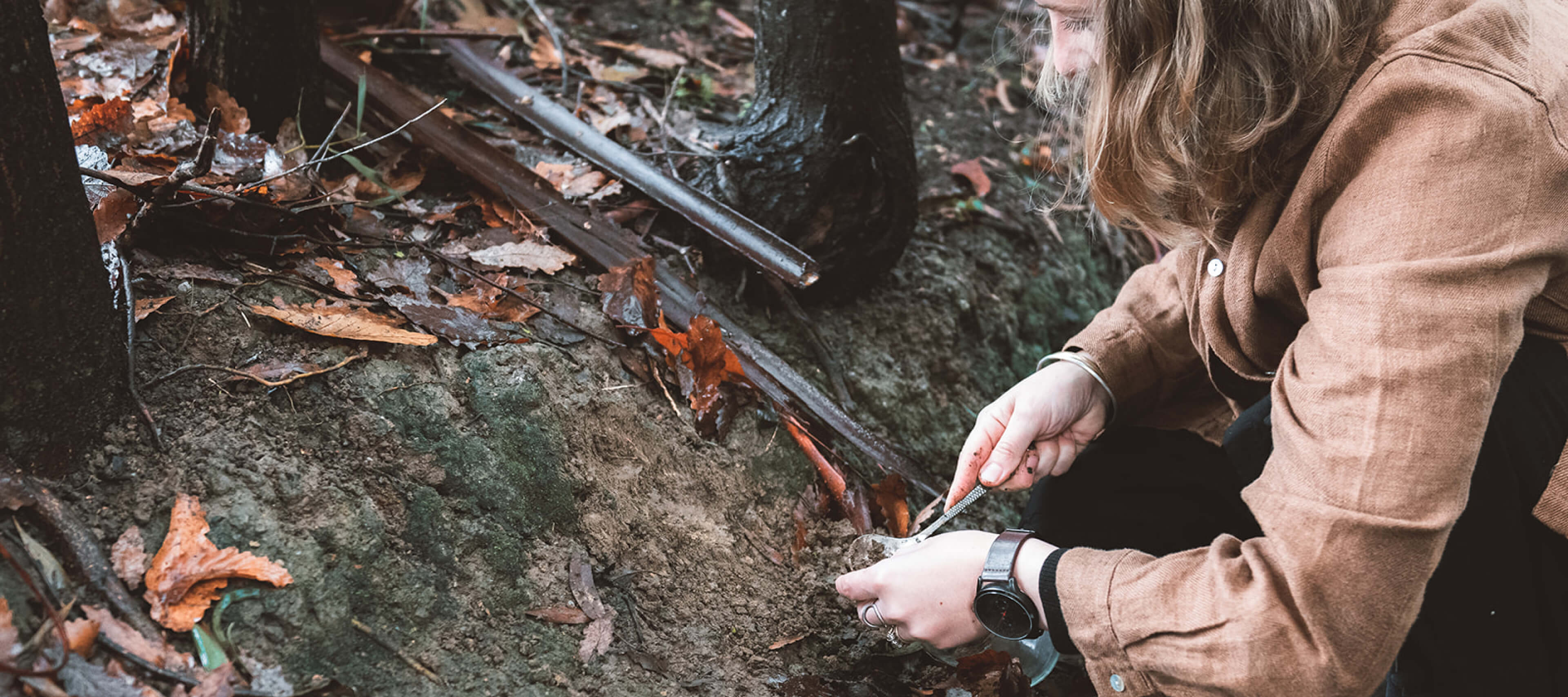
Artist Lucy Hersey draws on the earth – from crushed grapes to crumbled rocks – to create artworks that celebrate her local environment.


Growing up in Mount Martha on Victoria’s Mornington Peninsula, Lucy was always one mind-clearing walk away from the bush or beach. Her surroundings naturally inspired her – sometimes in unlikely ways.


“I was an insufferable collector, always bringing home weird things from my adventures,” she says. “One day I brought home a dead gummy shark that had washed up on the beach.”


Lucy told her mother she planned to keep the metre-long shark and preserve it. Her mum’s response? “No, you’re not.” The shark was eventually returned to the shore.


Lucy’s interest in the landscape didn’t waver, though; she’d pick up feathers, bones and other assorted objects and give them a creative use.

“I think that connection with the environment, nature and tuning into my surroundings really started then,” Lucy says.

She also felt driven to prevent waste, and one of her earliest artistic feats was making jewellery from broken plates. “There’s definitely an element of wanting to recycle and save stuff from landfill,” she says.


From scientist to artist


Although she loved being creative, Lucy pursued a career in science because it seemed like the grown-up thing to do. This led her to a role in medical research – and a childhood spent scavenging, as unconventional as it was, proved relevant to her career.


“I was looking after sharks that were part of a breeding program,” she says. “It was the coolest project.”


Lucy got to draw on her visual skills, too. She produced images of shark embryos while using a massive microscope. Looking after microscope imagery was like photography (“it requires a compositional eye”) and her role involved illustrations. Lucy even ran an artist-in-residency program at the research institute, which allowed creative figures to tail scientists. “I got to do heaps of art while I was a scientist, which was fun.”


In her spare time, Lucy stayed creative.

A low-impact approach


The self-taught artist initially experimented with acrylics but struggled to find her own style. When she was introduced to earth pigments in 2015, though, suddenly everything clicked.


It was another artist who provided that breakthrough for Lucy. “She gave me four little pots of ground earth from her property,” Lucy says. They resembled modest spice jars, but they had a profound effect. “It changed the whole trajectory of my career.”


Lucy loved the natural textures these paints produced. They also had a gentler impact on the earth compared to acrylics – which came in plastic tubes, were wrapped in lots of packaging and felt artificial on the canvas. “It looked just a little bit fake,” the artist says.


By contrast, the earth pigments didn’t produce extra waste or strong chemical fumes and could be easily washed down the sink. This approach resonated with Lucy’s lifelong appreciation for the environment.


Nature as inspiration


After her son was born in 2019, Lucy decided “to give full-time art a go”. She’s since become known for her trademark ‘earth paintings’, which get their colour, shading and tactile details from natural elements – ranging from berries to crumbled rock.


The artist is currently based in Loch, a South Gippsland town that’s approximately two hours outside Melbourne, where she looks after cattle on the family farm. “My studio’s in my garden,” she says. “It’s quite beautiful.”


The landscape slopes with rolling hillsides, and there’s bush and the Bass Coast to draw materials from.

“I go over to the coastline a lot to forage for pigments. The cliffs are a good spot,” she says.

She’ll search out fallen rocks or trenches left by roadworks, and the plants sprouting or flowering in her garden sometimes make cameos in her work, too. “I don’t want to cause erosion. I try to be low impact.”


For her floral compositions, Lucy will look out for sculpturally interesting forms. “That’s why I usually grab banksias or proteas,” she says. “I keep them in the house for a while as well [so they’ve] got to be beautiful to look at in a painting and at home.”


Lucy tries to create a deep sense of place in her artworks. For a recent collaboration with ARC Wines in West Gippsland, the textures and blemishes from their grapes, wine and soil ended up in the finished wine labels.


Looking to the future


Most of Lucy’s current collection can be seen at Gallery Rayé, but she is working on some exciting new ideas this year. “Also, I’m in the process of building a small gallery studio in town,” she says.


She sees all these things as interconnected. “My painting is just an expression of how I feel about my life and my love for where I live,” she says. “It’s an appreciation and a celebration.”

By Lee Tran Lam

Discover more from the world of Mercedes-Benz.