Yayoi Kusama. Courtesy of Ota Fine Arts YAYOI KUSAMA. Photo: Yusuke Miyazaki
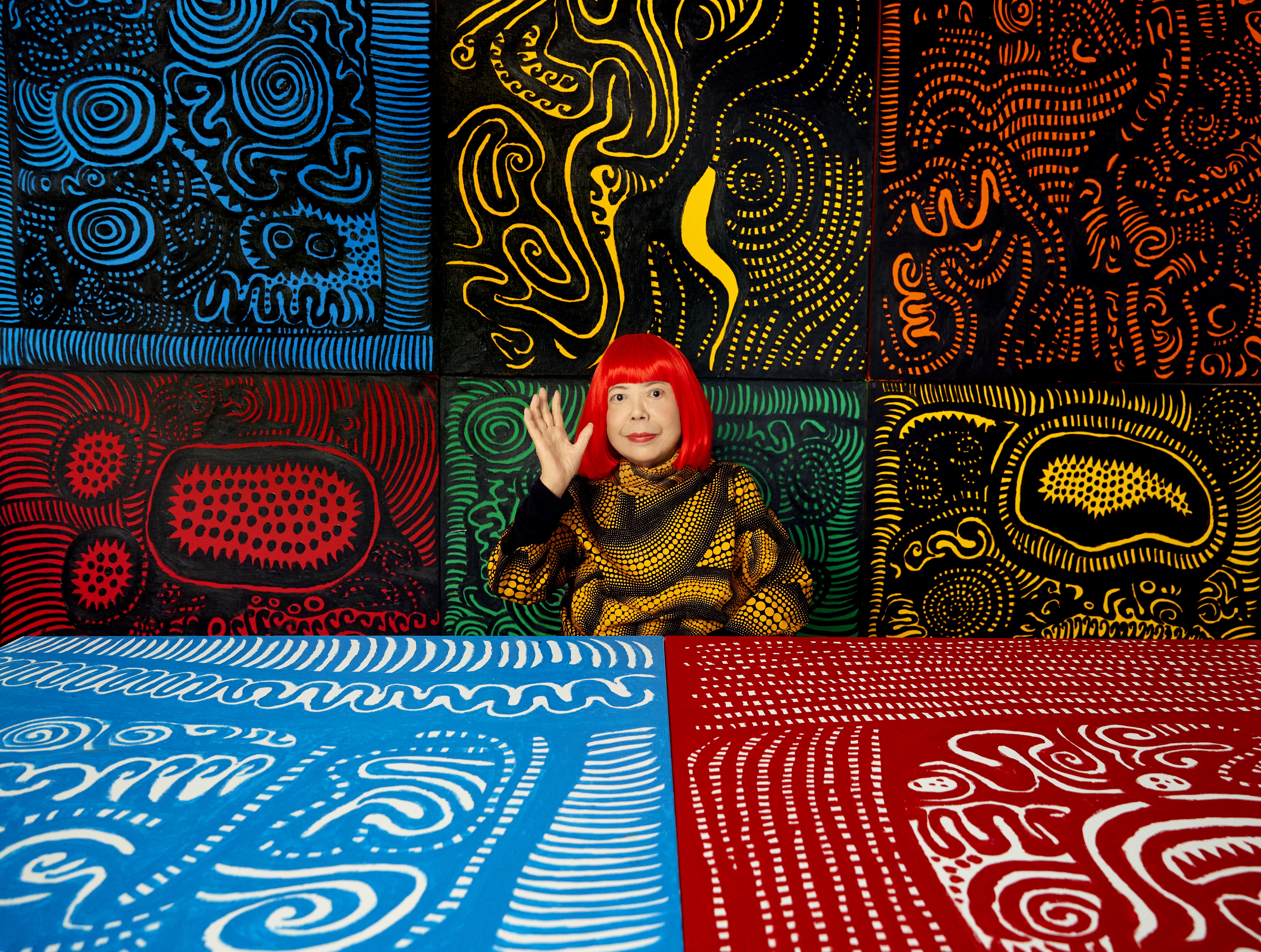;Resize=(828,828) "Yayoi Kusama smiling and waving")
The infinite legacy of Yayoi Kusama.
One of the greatest artists in living history, Yayoi Kusama has turned a lifetime of extraordinary challenges into timeless artworks.
February 2025
Few artists have captivated the hearts and minds of generations like Yayoi Kusama. For over 80 years, the Japanese artist has turned a lifetime of extraordinary challenges into beautiful and profound works that resonate with audiences around the world.
A self-described “obsessional artist”, Yayoi’s work is distinctive and repetitive, featuring signature motifs such as polka dots, flowers and yellow pumpkins. She is renowned for her ability to work across various creative mediums, producing everything from paintings and sculptures to installations, performance art, fashion, textiles, and photography – exploring themes of repetition, infinity, reflection, oblivion and self.
But long before she captured the popular zeitgeist, Yayoi came up against many challenges – a family who discouraged her from pursuing art, the male-dominated art world of the 1960s and 70s, and her own personal struggles – all of which have shaped her approach to art and contributed to her enduring legacy.
Dots Obsession
Born in 1929 in the rural town of Matsumoto, Japan, Yayoi showed an affinity for art from a very young age. Though her conservative family didn’t support her creative pursuits, this didn’t deter her from drawing and painting throughout her childhood.
Much of her work was – and still is – informed by the vivid hallucinations she has experienced throughout her life. From around the age of 10, she recalls seeing “flashes of light, auras, or dense fields of dots”, as well as plants coming alive and talking to her.
Though terrifying, these psychedelic experiences transfixed Yayoi, who poured them into her art.
She describes one hallucination she experienced in 1954 in detail: “One day I was looking at the red flower patterns of the tablecloth on a table, and when I looked up I saw the same pattern covering the ceiling, the windows and the walls, and finally all over the room, my body and the universe. I felt as if I had begun to self-obliterate, to revolve in the infinity of endless time and the absoluteness of space, and be reduced to nothingness.”
“When we obliterate nature and our bodies with polka dots, we become part of the unity of our environment.”
From these visions emerged one of Yayoi’s signature motifs: polka dots. They have featured over and over again in her work – from paintings and sculptures to installations and clothing – immersing the viewer in a seemingly endless world of pattern and colour. Perhaps the most notable example of this is Dots Obsession (1996), which featured an array of amorphous polka-dotted inflatable objects.
For Yayoi, the polka dots symbolise the infinite nature of the universe. “Our earth is only one polka dot among a million stars in the cosmos. Polka dots are a way to infinity. When we obliterate nature and our bodies with polka dots, we become part of the unity of our environment,” she says.
Her iconic infinity room installations are an elaboration of this theme. Floor-to-ceiling mirrors create the feeling of limitless space inside a room, multiplying the patterns and sculptures within until they feel as if they could go on forever.
Personal and political
It's hard to overstate the influence Yayoi has had on the contemporary art world.
When she moved to New York in 1958, she was one of the few women artists in a highly competitive, male-dominated art world. Nevertheless, she quickly became a vital part of the city’s avant-garde, post-war art scene alongside contemporaries such as Andy Warhol, Claes Oldenburg and Donald Judd. In 1959, her Infinity Nets series – featuring an array of large abstract paintings with intricate, monochromatic, repetitive patterns – secured her first solo exhibition in the US.
What distinguished Yayoi from her peers was the intensely personal nature of her artwork. One example is Walking Piece (1966), a slide projection depicting the artist exploring the streets of New York dressed in a floral kimono, conveying her feelings of alienation and loneliness – an outsider in a city of millions.
Other works, including her performance art, were highly political. Some were part of anti-war protests staged around iconic New York landmarks, while others were designed to make a statement about the world we live in. At the Venice Biennale in Italy, for example, she installed Narcissus Garden (1966) – 1500 mirrored orbs laid out on the ground – without invitation. The installation offered a dual commentary on the commercialisation of the art world and the human tendency to enjoy our own image.
“There are nights when I cannot sleep simply because my heart is bursting with the aspiration to make art that will live forever.”
Though controversial at the time, these kinds of social demonstrations further cemented Yayoi’s status as a modern cultural icon. The artist has also been vocal about the intersection of her art and mental health; her openness about using art as a coping mechanism has sparked important conversations about mental health in the art world.
Celebrating her life’s work
To celebrate the enduring legacy of this incredible artist, the National Gallery of Victoria (NGV) has curated one of the most comprehensive retrospectives ever presented globally. The Yayoi Kusama exhibition, of which Mercedes-Benz Australia is a proud Principal Partner, includes 200 works spanning her childhood to 2024.
Opened in December 2024, Yayoi Kusama is the largest exhibition of her work in Australia to date. The NGV foyer features her signature Dancing Pumpkin (2020), while the silver orbs from Narcissus Garden (1966) are placed near the NGV’s iconic waterfall entryway. Highlights include her famous piece The Hope of the Polka Dots Buried in Infinity Will Eternally Cover the Universe (2019), alongside earlier works from the 1960s.
One of the most exciting elements of the new exhibition in Melbourne is her latest immersive work, titled My Heart is Filled to the Brim with Sparkling Light (2024). Created exclusively for the exhibition, it consists of an infinity of disco balls. This modern immersive work is complemented by a series of new, smaller canvases painted in recent years.
“What I think about first and foremost is that I want to create good art,” she wrote in her 2002 autobiography.
“That is my sole desire. It would be futile and meaningless to focus on the shrinking time frame before me, or to think of my limitations. I shall never stop striving to create works that will shine on after my death. There are nights when I cannot sleep simply because my heart is bursting with the aspiration to make art that will live forever.”
On display until April 21, 2025, the exhibition is not just a culmination of her life’s work, but also a fitting tribute to the legacy and unique artistry of one of the world’s greatest living artists.
Discover the Yayoi Kusama exhibition at the NGV.