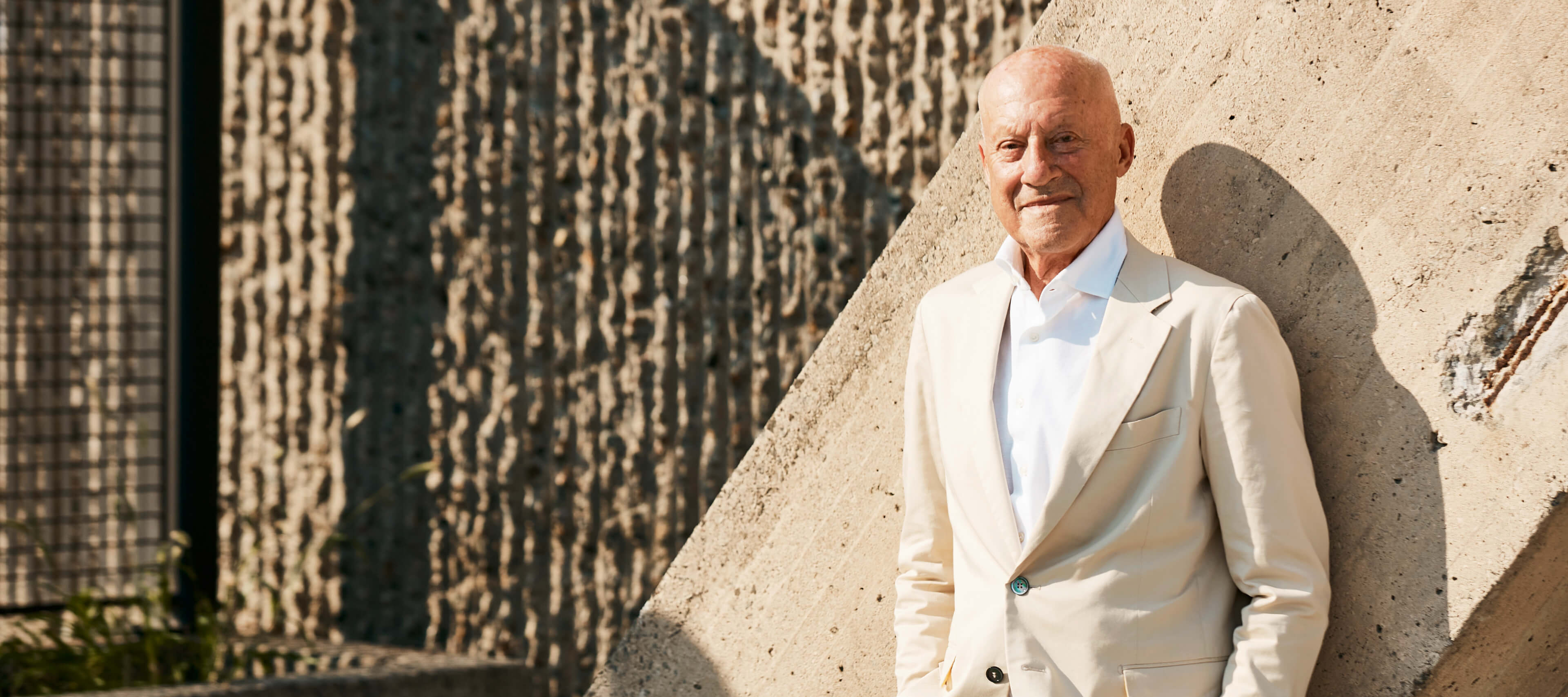
;Resize=(828,829) "Architect Norman Foster")
Mercedes-Benz: Lord Norman Foster, you recently co-curated the “Motion. Autos, Art, Architecture” exhibition for the iconic Guggenheim museum of Bilbao. The title opens quite an epic panorama. How did you approach the exhibition?
Norman Foster: If you try to sum up what characterises our age, then it is a post-horse-drawn age that is one of motion, speed, movement, dynamic – and the automobile is the very epitome of that. Cars are perceived by some, including me, as being like sculptures or paintings. Indeed, many have been created by people who were trained as artists, some by architects, some by those that come from artistic families. If you consider how cars are designed in a studio: it’s still all about sculpting in clay just like in the studios of the Renaissance. And there’s a cultural link to artists who have anticipated the streamlined forms of vehicles – whether that’s Constantin Brâncusi or Umberto Boccioni, or the beautiful curves of a Henry Moore sculpture.
There is an aesthetic dimension to the automobile, which has created a symbol for the 20th century, however, perhaps we are now reaching the end of that epoch. So it is time to celebrate the impact of the automobile. No other invention has been as liberating for individuals whilst, at the same time, transforming the landscape so deeply. There are a number of narratives like these in the exhibition - some obvious, some less so.
MB: It is fascinating how the perception of the car has changed during the last decade…
NF: You will discover that around the beginning of the 20th century, the car was a saviour. Cities were a deluge of horse manure, dead carcasses, disease and stench. The car beautified and cleaned the city but, over time, it became the villain to some. But, is it about to reinvent itself? Just remember: It was considered revolutionary when the “Moon Buggy”, the first vehicle on the Moon in 1971, drove with electric motors in its wheel hubs. However, in the exhibition we actually see a car from 1900 with the same concept. Leap forward to the present day and we are now slowly beginning to prepare our cars for autonomous driving. But again, that isn’t a new idea. There are images of autonomous driving in the exhibition – a family playing a game on a round table in a vehicle which is speeding along the highway by itself in the early 1950s.